Showing posts with label Invasive Species. Show all posts

Thursday, September 28, 2017

Carp management expands to Lake Owasso Chain


by Chris O'Brien


Following recent success managing common carp in the Phalen Chain of Lakes, the Ramsey-Washington Metro Watershed District is now setting its sights on the Lake Owasso system. With four interconnected lakes (Owasso, Wabasso, Bennett and Grass) and twelve shallow ponds, the system offers prime habitat for carp to potentially out-compete native gamefish, uproot aquatic vegetation and harm water quality.

Carp management in Lake Owasso and connected lakes is part of the District’s goal to control phosphorous-loading in these waters. As carp root for food along the lake bottom, they stir up phosphorous-laden sediment, which in turn contributes to turbid water and algal blooms.

The key to keeping carp in check is figuring out how many there are, where they go, and how they spawn and recruit (survive to adulthood). Using this information, the District hopes to efficiently remove large numbers of adult carp while also limiting their ability to repopulate the system.


Counting carp

The District enlisted Jordan Wein of Carp Solutions to conduct a general population assessment through electrofishing this summer. After calculating a biomass estimate, they found that each lake in the chain contained more than 100 pounds of carp per acre, the threshold generally considered to inhibit water quality. Most concerning were Lake Owasso and Lake Wabasso, which each turned up more than 400 pounds of carp per acre.

The team also marked over 200 carp with a fin clip as part of a mark-and-recapture study to verify these estimated population numbers. “We’re being strategic by marking the carp now so that when we eventually harvest them, we’ll be able to get a good estimate of how many were in the lake,” explained Bill Bartodziej, RWMWD Natural Resources Specialist.


The video below shows the Carp Solutions team using box nets baited with corn to capture large numbers of carp on Lake Owasso.


Location, location

In addition to the population assessment, Carp Solutions surgically implanted radio transmitters in 20 adult carp to figure out where they congregate in the winter and where they spawn in the spring. Since carp tend to travel in dense schools, the radio-tagged fish will likely betray their rubber-lipped brethren and help the research team track seasonal movements of the larger population. 


One of 20 adult carp implanted with radio tags, which will
help the District track seasonal movements and develop a
comprehensive carp control strategy for the Owasso system.


At 37 feet deep, Lake Wabasso is likely an overwintering hotspot for carp. Using radio telemetry to pinpoint locations where thousands of carp school up under the ice, the District plans to enlist a commercial fishing operation to harvest these fish with large sein nets.
 

Carp nurseries

While netting adult fish should put a dent in the carp population, confirming spring spawning locations could be key to a long-term management strategy. “It’s very unikely that carp are successfully reproducing and recruiting in Wabasso, so they are probably spawning elsewhere in the system,” said Wein.

Bluegills are voracious predators of carp eggs and tend to control numbers of young carp in large lakes. However, shallow ponds and wetlands often serve as carp nurseries where they can hatch by the millions and grow in relative safety from predators. Future management strategies may include setting up barriers to keep carp out of these nursery areas, netting them there and/or stocking bluegills to eat the carp eggs.

Over the last five years, District
carp management in the Phalen Chain has reduced carp density by over 60 percent. Among those efforts was eliminating carp in Lake Casey (a former carp nursery in North St. Paul) by drawing down the water level, allowing carp to winterkill, and then stocking bluegills and largemouth bass. Tracking the movements of Owasso carp could help identify similar carp nursery locations and allow the District to rein in these prolific fish.

Monday, August 22, 2016

Planting your Yard to Help Nature and Wildlife

By Carole Gernes, Ramsey Conservation District

Avoid invasive species like Miscanthus sacchariflorus (Chinese Silver Grass)! It escapes from ornamental plantings and forms large clumps along disturbed areas, displacing native vegetation.
Photo Credit: Paul Erdman


Fall is a great time for planting! Mindful planting in your yard can help struggling pollinators, birds and native plant communities nearby. 

Help Pollinators by Avoiding Neonics

Alarming articles about disappearing monarch butterflies and bees are all over the media. One way to help pollinators is to avoid buying plants and seeds that are treated with systemic pesticides; sometimes called neonicotinoids or neonics. Stores may have signs saying their garden/vegetable plants are systemic pesticide-free, but still sell treated seeds, flowering plants, shrubs and trees. These pesticides move to tissues of the entire plant, including flowers and may stay in the plant for years. They do not wash off. Pollinators that visit treated flowers may be killed instantly, experience a slow decline in health leading to death or be unable to reproduce. Look for seed companies that offer “untreated seeds” and ask before buying plants. Click HERE for more information on native plants for pollinators.


Don't Plant Invasive Plants
Avoiding planting invasive species will also help pollinators, birds and local natural areas. Invasive plants are non-native plants that can move from your yard to take over native plant communities; like prairies, savannas or woodlands. They replace the diversity of plant life that our birds, pollinators and other wildlife depend on for food and shelter. A variety of plants are important to keep them healthy.

Japanese Knotweed blooms late, but should not be planted for pollinators.
Photo Credit: Carole Gernes, RCCWMA

Even though pollinators will visit a specific invasive flower, a diet from only one kind of nectar or pollen is not healthy. Bird nests are susceptible to predators and they find fewer insects to eat in invasive shrubs.
Three invasive plants to avoid: Dame's Rocket - Queen Ann's Lace - Greater Celandine
Photo Credits: Peter Dziuk (Minnesota Wildflowers) - Carole Gernes (RCCWMA) - Kristin Willette (Volunteer)


Not all invasive plants are illegal; many are still sold in nurseries and online. Do an online search of your prospective plant along with the word “invasive”. One advantage of living in the Midwest is that species move here after being “tested” first on the east and west coasts. Species that are causing problems there may be a preview into our future. 


Avoid planting “wildflowers in a can” seed mixes. If you are interested in planting native wildflowers, buy from a native plant nursery within 200 miles of your planting site. More invasive yard plant information may be found HERE, or at the Cooperative Weed Management Facebook Page HERE. Dig a little deeper to help nature. It’s worth the extra effort!

Check HERE for plants you should avoid planting your yard.

Tuesday, February 16, 2016

Battle Creek Buckthorn Project In Motion ...

 
Crew stacks woody invasives in Battle Creek Regional Park


Ramsey County has begun a multi-year, $288,000 project to clear out invasive species and
restore native vegetation in Battle Creek Park. They're focusing on a large swath in the northwest corner of the park. The Ramsey County Parks and Recreation Department will complete ongoing restoration improvements to the oak savannas, woodlands and prairies in the northwest section of Battle Creek Regional Park from summer 2015-2018.


A DNR Conservation Partners Legacy Grant through the Outdoor Heritage Fund, provided by the Clean Water, Land and Legacy Funds, is covering ninety percent of the costs of this project. The remaining ten percent of the project funding is being matched by Ramsey County. 


The restoration work will include permitted prescribed burns (planned for spring 2016 and 2018), removal of buckthorn and other invasive woody material, and sowing of native seed over the seventy-acre site.
Buckthorn cut at Battle Creek Regional Park


According to Mike Goodnature, that area is being targeted "because it contains a unique mix of habitat types, such as oak savanna, wetland seeps and bluff prairie areas".


Oak woods are opened up after invasive removal.

The goal will be to improve habitat for deer, nesting birds and migratory waterfowl that travel along the Mississippi River corridor. It’s an ambitious and noble goal. We appreciate your efforts, Mike!

Monday, October 12, 2015

Carp Talk – Keeping Tabs on Carp in the Phalen Chain

Jordan Wein measures carp caught in Kohlman Lake box nets.
Photo credit: Anita Jader

By Bill Bartodziej

Over the last six years, we have made substantial progress in understanding the common carp population and ecology in the Phalen Chain of Lakes. We have learned that carp densities over 90 pounds per acre typically result in negative impacts to lake water quality. This has become our long-term carp management target. 

We also discovered that carp actively spawn in the main lakes, but bluegill sunfish consume most of their eggs. However, adult carp in small lakes, ponds, and connecting wetlands can be very successful in producing young carp if bluegill are absent. So if we want to keep carp at low levels in the main Chain of Lakes, we must turn to managing these small connected waters. 

We have located the key spawning areas that are connected to the Chain and have been actively working to eliminate the juvenile carp in these systems (e.g., Casey Lake, Markham Pond, Owasso Basin, and Kohlman Basin).
This map shows key targeted areas in the Phalen Chain where carp management
has been in progress in the past few years.

This year the Watershed District contracted with Carp Solutions, LLC, to conduct carp survey work in connecting ponds and small lakes and to trap adult carp in the main Chain of Lakes. District Natural Resources staff have been working closely with Dr. Przemek Bajer of Carp Solutions and his staff. This effort is progressing very nicely and the results have been encouraging.


Adult Carp Management
 

We will continue to reduce the adult population in the main Chain of Lakes over the next several years. At the beginning of this year, we estimated that there were 2,900 adult carp remaining in the Phalen Chain. Through summer box-netting (images below), we have been able to remove 500 carp to date. This is over 17% of the remaining adult carp population. Although this not glamorous work, summer box-netting has proven to be a very useful carp management tool. For the purpose of systematically reducing the carp population at a reasonable cost, this seems to be the most effective tool at this time.


Over the last several years, we have reduced the adult carp density by over 60 percent, from 158 pounds per acre to 55 pounds per acre (average biomass for Kohlman, Gervais and Keller Lakes). We are now well under our 90 pound per acre management goal. The captured carp are making their way to the Ramsey County Correctional Facility greenhouse where compost is being produced. A good portion of this compost material will be used to grow native plants at the nursery.


Cracked corn is used to attract carp into the box nets. Natural Resources Technician, Simba Blood,
and interns, Thea Evans (left) and Carrie Taylor (right), bait trap nets.


In addition to being an effective tool in carp removal, the box netting effort suggests that young carp are not common in the Phalen Chain. So far we have not captured a juvenile carp in the netting operation. All the fish have been big adults. These results support the idea that substantial carp recruitment (young fish moving into the adult population) has not taken place in 2014-15 in the main Chain of Lakes. This is very good news!


Herding captured carp into the corner of the box net for removal.

Keeping Tabs on the Nursery Areas


Trap nets were set to capture small fish in carp nursery areas in the northern part of watershed. Good news! No young carp were sampled in Markham Pond, Casey Lake and Willow Lake. Additionally, other survey work suggests the absence of adult carp in these systems. This confirms that we are making progress in effectively managing these systems and eliminating the threat of large numbers of juvenile carp moving into the Chain.

Trap nets set in Markham Pond. No carp were found.

Kohlman Basin Management

Kohlman Basin is a ponding and storm water treatment area that receives water from Willow and Kohlman Creeks; water exits and makes it way to Kohlman Lake. The main basin is located on the south side of Beam Avenue between Highway 61 and Hazelwood Street across from Costco. Previous survey work (Justine Koch’s thesis study, U of MN) suggested that there were a few hundred adult carp, and surprisingly, some gamefish in this Kohlman Basin system. 


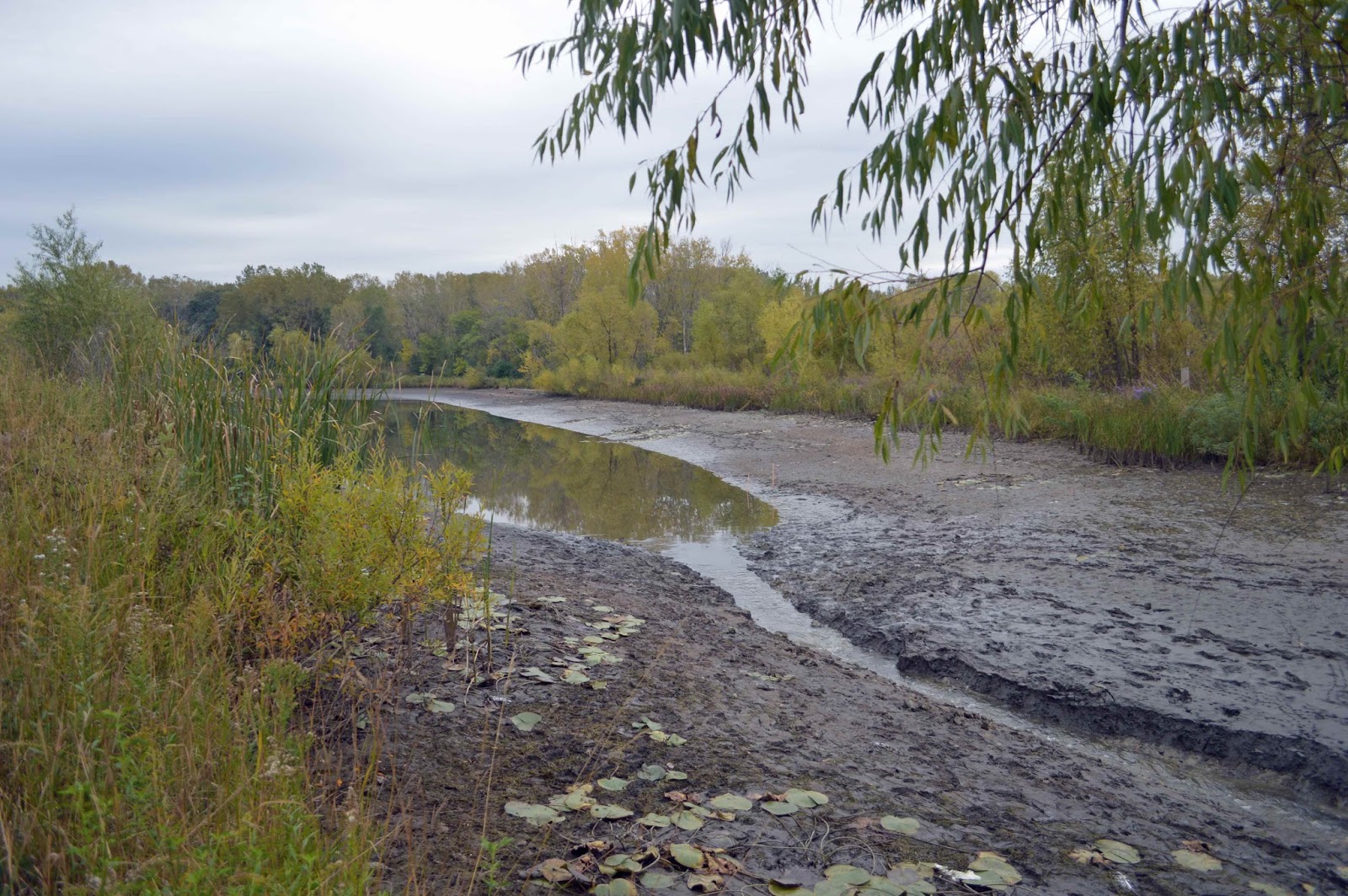
The drawdown of Kohlman Basin, a wetland complex located along Beam Avenue in Maplewood.


This year, only one young carp was found in a small connecting wetland just to the north of Kohlman Basin (we did not survey for adults). Although only one juvenile carp was netted, this is an indication that carp are successfully reproducing in this system. Thus, this confirms the necessity to manage these systems to minimize the risk of a large year class of juvenile carp being produced.


Stephen Theis, RWMWD Natural Resources Intern,
sets up a net at Kohlman Basin outlet before the drawdown
.

On October 1st, watershed staff opened the outlet and began to draw down Kohlman Basin and the connecting wetlands to the north. Our main objective is to drain most of the water and then net carp in the remaining pool. We will preserve all the gamefish in the system. After our fall harvest, the outlet will be closed, and the basin will be filled before winter. We will certainly keep you updated on this carp management effort.


The drawdown of Kohlman Basin in progress. View is facing the outlet on the west side.


K
Keep your fingers crossed that the Kohlman Basin drawdown is successful. Rest assured our work with carp is not over yet. The Watershed District intends to comprehensively manage carp over the long-term in the Phalen Chain of Lakes. Stay tuned to your local dial for the next installment.

"Working on removing carp from the Phalen Chain of Lakes! This haul from Lake Gervais
was 46 adult carp, or as we prefer to think of it, 50 million future fish."

- Simba Blood, RWMWD Natural Resources Technician


“A scrapbook of carp photos isn’t complete without a shot of
Jordan Wein’s latest catch from a box net.”
   - Sage Passi

Wednesday, August 12, 2015

Kristin Willette, Invasive Plant Patrol Volunteer with a Mission

By Sage Passi

Kristin Willette walks a trail in Battle Creek Park on the hunt for targeted invasive plants.


I have my internal GPS system trained to find people with a passion and a mission. I know there are people out there in the watershed doing dedicated, important work. My mission: Find them wherever they are and cover their story.

I’ve been curious about what entices invasive plant volunteers to become involved. I asked Carole Gernes, Coordinator for the Ramsey County Cooperative Weed Management Area, if I could trail one of her volunteers. I was pleased when an opportunity to meet Kristin Willette, arose in July. Kristin is an enthusiastic volunteer who looks for early detection target species in several areas.

Earlier this spring Carole organized two Invasive Plant Patrol trainings, one in Maplewood and the other in Tamarack Nature Preserve, to train volunteers to learn how to be extra eyes with the goal of stopping new invasive species from gaining a foothold in the county. New invasive plants just moving into the area are referred to as early detection species.
Volunteers hike on and off trails, mark locations of invaders and report them for removal.

Carole Gernes, coordinator for the Ramsey County Cooperative
Weed Management Area, with oriental bittersweet, an invasive threat.

The Ramsey County Cooperative Weed Management Area (RCCWMA) is a cooperative relationship between government agencies, businesses, non-profit organizations and other interested groups working towards managing early detection species that could impact natural lands, parks and open spaces in Ramsey County. RCCWMA began its volunteer program in 2010 with Early Detectors working in Maplewood and North St. Paul. Additional volunteers in Roseville, Shoreview, White Bear Lake and St. Paul joined the efforts in the past couple years. The plants that are on their radar are listed below. They are grouped in the following categories: 

Early Detection Target Species in Ramsey County

Noxious weeds which must be eradicated by law
  • Grecian foxglove
  • Cut-leaf teasel
  • Oriental bittersweet
Noxious plants which must be managed by law
Minnesota Restricted Noxious Weeds
Minnesota Aquatic Invasive Species; illegal to possess, propagate or transport
  • Flowering rush

Other species that threaten ecosystems

  • Japanese hedge parsley
  • Miscanthus ssp.

Carole’s training sessions enable volunteers to practice identification with herbarium species. They learn how to identify and distinguish these targeted species from beneficial look-alikes. 

Kristin, acknowledged, “Carole has been most encouraging and responsive. I feel I am actually helping directly in an effort I care about very much! I started studying exotic invasive plants and animals back in grad school in the 1980s and have always had an affinity for weeds.” 
 
Kristin and I decided to rendezvous at her house because I wasn’t sure I could pinpoint where to meet at Battle Creek Park. Before we left to go to the park, she sat down with me in her living room to share her story about how she chose to get involved in being an “Early Detector”.


A couple years ago Kristin moved to a townhome in St. Paul from her house near Lake Nokomis in Minneapolis. It was hard moving to a place without a yard so she said she was happy to discover a place like Battle Creek Park to hike and explore not far from her new home.
 
Kristin Willette has a strong fascination with both "weeds" and native plants.

“The mountain-bike trails at Battle Creek Park are my closest and favorite places to walk. There’s a 'wildness' there, in the midst of the city, but the park also has every kind of human impact you can find. I have found relatively rare plants there, as well as plenty of weeds and invasives. I retired recently and getting involved in this program has been like returning to an earlier time in my life, growing up on a farm in southeastern Minnesota. During my childhood I got very familiar with weeds and how they behave.” Her interest and study of exotic plants and animals took off even more intensively during her years as a graduate student in the 1980s.

I followed Kristin in my car and we drove to one of the entry points she uses to get into the park. To my surprise, I realized that this was at the same location I have arranged for buses to drop off students when I’ve led tours in the park.


One of the plants that soon grabbed her attention when we met at the entrance and walked into the park was Japanese hedge parsley. It wasn’t obvious to me at first with my untrained eye, but I soon began to notice how common it was in various places along the trail.


Kristin Willette with Japanese hedge parsley at one of Battle Creek Park's trail heads.


Japanese hedge parsley is a biennial that invades woodlands and woodland edges
and roadsides. It establishes as a rosette with parsley-like leaves in the first year.
Photo credit: minnesotawildflowers.info


Japanese hedge parsley flowers in midsummer, producing small white,
flat-topped umbels. Under each umbel are a number of narrow bracts.

Photo credit: Simba Blood


The seeds of Japanese hedge parsley, produced later in the
summer, are bristly and will attach to your clothes

Photo credit: minnesotawildflowers.info


I asked her what was one of the other targeted Early Detection plants she has found in the park.

“Narrowleaf bittercress,” she responded.

I had to admit I didn’t know how to recognize the plant.


Narrowleaf bittercress
Photo credit: minnesotawildflowers.info

Narrowleaf bittercress is a new invader to Minnesota. Kristin said she has found it in several places in Battle Creek Park – in one area she calls “the absolutely horrible area” - a spot with more invasives than she can report or pull, but also in a beautiful area where early meadow rue, Canada mayflower and false rue anemone grow in a forest of ferns. This bittercress grows vigorously in deep shade and woods, covering the ground in dense patches. It can also be found on banks, thicket margins and on moist limestone rocks and cliffs. It can be differentiated from other mustards and bittercress by its membrane-like, narrow, pointed ears or auricles which extend from the leaf base to grasp the stem. These ears remain on the stalk when leaves are removed. Kristin surmised that it was probably transferred to that wooded area via the off-road bicycle paths that connect to those out of the way places in the park.


Arrowhead and reed canary grass are two of
the common species along Battle Creek's edge.

Most of my walking tours with kids have always focused on the creek. I’ve never really stopped to look at the larger diversity of plants set back from the trail tucked under the canopy of trees. The densely growing canary grass and two natives, the arrowhead and an occasional swamp milkweed growing along its banks are the typical plants that have absorbed my interest, but now with her direction I found myself beginning to notice the tucked away areas where Kristin keeps her eye out for “what does not belong.” I was excited to see dense patches of wild ginger, sensitive fern and other ferns interspersed with meadow rue and other native woodland species.
  

One of the out-of-the-way trails that Kristin includes in her monitoring walks.

As we walked further into the park, it became more obvious that the Japanese hedge parsley has asserted its way into the park. But as Kristen reminded me, trying to keep it from getting a foothold in the out of the way places where a bike or a footstep might carry its seeds to less trodden, diverse woodlands in the park is still an important mission. I asked her to point out one of those trails. We headed a short distance up one of the dirt trails and her eyes were soon fixed on a couple of stray Japanese hedge parsley plants that had found their way into the woodland mix. In a couple more seconds those Japanese hedge parsley were no longer there.


Kristin removes some Japanese hedge parsley growing off the beaten track.


I appreciate Carole’s summary of Kristin’s level of dedication.

“She’s like the One Woman Battle Creek Improvement Association!” 

I’ll ditto that.

Back on the creek trail I noticed that Kristin had stopped for a moment and was taking a photo of a plant on her phone that drew her suspicion. She told me she’s delighted to have a feature on her phone that allows her to map the location points where she had detected something she wants to report.


Kristin snaps a shot of a tall plant in question.

 
She wasn’t sure of the plant’s identity but she said she would do some more research and let me know what it was. A couple of days later I got this e-mail from her,

“That big plant I was worrying about at Battle Creek, I thought was Giant Hogweed (Heracleum mantegazzanium). But what we saw is more likely Cow Parsnip or some other member of the Umbelliferae family. I sent a picture to Carole Gernes, but really I should go back and (now that I know what to look for) examine the stem for purple blotches and stiff white hairs at the joints. Details, details!”


When I asked Carole about this plant that Kristin was concerned about, she informed me that Giant Hogweed hasn’t been seen yet in Minnesota.

“But it is knocking on the door.” It has been reported in Wisconsin and Michigan. It causes burns like wild parsnip but if you get the sap in your eyes, it can permanently blind you. It can grow to fifteen feet high with leaves five feet wide and a huge stem four to five inches in diameter. To eradicate that plant you need to use a full hazmat (protective body suit) with a face shield.” With all this information I couldn’t help conjuring up images of a knight in armor going after the fierce Giant Hogweed.


After I left Kristin that morning, she soon took off on the trail of another suspect. This is what she later had to report,

“After seeing you I looked at a vacant lot along Old Hudson Road. If you click on the Google maps link below you will get a map; the satellite view "Earth" reveals more. Tansy was growing there; it had been mowed off short, but was vigorously flowering at about 6" tall! Carole says they need to treat tansy when it is not flowering.”

I chuckled when she shared her e-mail to Carole with me.
 

Tansy
Photo credit: Carole Gernes

“It may not show in the photo, but a patch of tansy is out there. Wish I was taller!”

You may not be that tall, Kristin, but you have X-ray vision!


Look out, tansy! Someone will be coming for you!

Thank you to Kristin and all of the other dedicated volunteers who work tirelessly to help our natural world.


Ramsey County Cooperative Weed Management Area is a program of Ramsey Conservation District.

Up-to-date information about the Invasive Plant Patrol or early detection species in Ramsey County can be found on Ramsey County Cooperative Weed Management Area’s Facebook page: https://www.facebook.com/pages/Ramsey-County-Cooperative-Weed-Management-Area/201929346484468

Thursday, June 25, 2015

Wild Parsnip and its Look-Alike: Golden Alexander

 by Carole Gernes, Ramsey Conservation District; CWMA Coordinator

Wild Parsnip - A Minnesota Noxious Weed


Wild Parsnip leaves


Ramsey County hopes to prevent invasive wild parsnip from becoming established in the county. Touching wild parsnip, a Minnesota Noxious Weed, may cause severe skin burns. An escaped garden plant, its seeds are spread by sticking to feet, tires and mowers.


Parsnip grows close to the ground the first year and up to five feet tall when flowering. Umbrella-shaped flower heads are two to 10-inches wide, containing many tiny yellow flowers. Leaves are feather-shaped, with many large-toothed leaflets growing from a central vein.


Golden Alexander


Wild parsnip flowers can often be confused with Golden Alexanders, a beneficial native plant. Golden Alexander leaves have small teeth along the edge and an overall palm-shaped or maple-leaf outline.

Excellent photos of Golden Alexanders may be found at
www.minnesotawildflowers.info.

Although parsnip generally starts blooming later than Golden Alexanders, this year there has been some overlap. 


If you suspect that a plant is parsnip, do not touch it.  Please report its location by emailing: carole.gernes@rwmwd.org, or 651-792-7977, giving a good description of its location and how big the patch is. Also take photos if possible. 


A wild parsnip "burn" four days after contact.
Photo credit: Sam Potter

Together we can stop this problematic plant from affecting our outdoor activities.

Pastinaca sativa - Parsnip
Photo Credit: Minnesota Department of Agriculture


Tuesday, March 10, 2015

Mystery of the Month: Catch-Me-if-You-Can Grass

Phragmites —Native or Not?
 

By Carole Gernes

What sly, new, invasive grass mimics its closest relative so well that it can slip under our radar until its take-over is well underway?

The chameleon is the non-native invasive common reed grass; Phragmites australis australis; a European subspecies of a common reed that has become invasive in the United States.

Historically, it has been traced to an East Coast shipping yard, where it was thought to have entered the U.S. as ballast. It is a perennial, up to 15 feet tall, with large golden or purplish flowering heads in the fall. 

These plants spread via a thick underground stem (rhizome) network, resulting in a dense monoculture that is difficult to walk through. As the infestation grows, it excludes and replaces beneficial native plants. This grass has overtaken large portions of Great Lakes shoreline.


Phragmites rhizome

Part of the problem with this plant is the difficulty in differentiating it from the native, North American, common reed, Phragmites australis americana. Clues to identification vary with the season. 
In late winter and early spring, check to see if the plants have leaves attached to the stems and large, intact, thick fluffy, golden brown, seed heads. If so, the grass is likely the invasive subspecies.
    
 Early spring invasive common reed (Phragmites australis ssp. australis)
Photo credit Ken Graeve; MNDOT

If flower heads are few, thin, ragged-looking and leaves have fallen off from winter weather, it is likely a native plant.

Early spring native common reed (Phragmites australis ssp. americanus)
Photo credit Ken Graeve; MNDOT
 
In summer, look at the color of the plants. The invasive plant has bluish tinged leaves. The native plant leaf is more yellow-green. On close inspection, the native plant will have green stems throughout, with areas on the stem (nodes) that area a reddish-maroon color. If you rub your fingers along the stem of the invasive plant, it will feel slightly rough and look dull. The native plant’s stem will feel smooth and look shiny.

 Invasive common reed                                                                     Native common reed
Photo credits Ken Graeve, MNDOT
 
Once plants begin to flower, you may notice differences in the size and color of the flowering heads. The invasive variety has larger, fuller looking tops, which may have a golden or purplish color. The native plants have smaller, thinner, golden-colored flowers.

Invasive Phragmites australis                                                           Native Phragmites americana
Photo credits Ken Graeve, MNDOT

Because this past winter saw less snow than usual, some stands of common reed have been difficult to identify. The most definitive characteristics require measuring flower parts and other small parts.

Phragmites species begin to bloom in late summer to fall. Isolated patches do not set seed; they spread by rhizome. Size of infestations increase quickly in areas where additional, genetically diverse, patches are introduced, starting seed production. Seeds are set very late - in late October to early November. Once viable seeds are set, they jump-start spread of the plant.

Great Lakes Phragmites Collaborative is a good resource for more information about invasive phragmites. Download a PDF version of the Phragmite Field Guide to help you distinguish between native and exotic forms of common reed.


How can you help?

If you find a suspected infestation, contact coordinator Carole Gernes at 651-792-7977 or carole.gernes@rwmwd.org.
 
Volunteer! Free trainings for the Invasive Plant Patrol citizen science program will be held in March and April.
  • Saturday, March 28 - Shoreview Community Center  To register, contact Carole Gernes at 651-792-7977 or carole.gernes@rwmwd.org.
  • Saturday, April 11 - Maplewood Nature Center  To register, call 651-249-2170 or online at www.maplewoodnature.com.
  • Saturday, April 25 - Tamarack Nature Center  To register, call Melanie Harding at 651-407-5350 extension 119. 
Note:  All class times are 10 am – 2 pm, with a 30-minute lunch break.