Tuesday, July 15, 2014

A New Threat to our Surface Waters?

By Cliff Aichinger

Water Quality intern, Wyatt, collects a water sample at the Casey Lake inlet.

Many of you have heard or read about the sewage spills or by-pass pumping that occurred in several locations around the Twin Cities on June 19th. One of these sites was in the City of North St. Paul near McKnight and South Avenue.  Is this type of incident a threat to our surface waters?  Yes. Is this a new threat? In recent years, our Metropolitan Environmental Services wastewater system has eliminated almost all wastewater discharges to our surface waters; even to the Mississippi River.  Discharges to our lake(s) and stream(s) used to be common before a metropolitan collection and treatment system.  We have grown comfortable in the knowledge that our sanitary and storm sewer systems are separate and don’t mix.  This is not the case in many large urban areas across the country.  As discussed below, this is preventable and shouldn’t continue to occur.
 
Due to sewer back-ups in a number of homes, the City of North St. Paul felt it needed to relieve some of the pressure and excess flow in the sewer interceptor line as it runs through the city. This obviously created quite a stir of concern over public safety.  Residents on our Phalen Chain of Lakes and users of the lakes for boating, swimming and fishing were left wondering if it was safe to enter the water.


District staff was concerned as well and provided monitoring assistance to determine if we had unsafe levels of E. coli in our waters. Unfortunately, we found out that we could not get a quick answer to this question.  Lab analysis of water samples for E. coli takes 36 hours to process.  We sampled every day for one week.  The City and the District gave notice to as many people and information outlets as we could, but this still did not reach everyone.  We took a cautionary position and asked the County to close Gervais Beach, which they did.

As a precaution, Gervais Beach was closed as a result of the upstream sewage by-pass.
 
We did learn that the wastewater pumped to Kohlman Creek was highly diluted and became more diluted as it flowed toward Kohlman Lake.  As it turned out, the E. coli levels bounced in the creek about a day after the discharge, but the lake readings never exceeded the health advisory levels.

As I told many people, this was a highly unusual situation. In fact, this was the first known sewage discharge or spill since the formation of the District in 1975.  The excess flow in the sewer interceptor was clearly caused by stormwater and groundwater getting into the sewers.  This is called I & I (Infiltration and Inflow). The Metropolitan Environmental Services, operators of our regional sewage treatment system interceptor pipes and treatment plants, have gone to great lengths to try to eliminate I & I by working with the metropolitan cities to repair old leaking pipes and to eliminate sump pump discharges to the sanitary system. This past spring and June rainfall created an unusually high ground water situation that resulted in a great deal of wet and flooded basements.  These conditions resulted in unusually high amounts of basement floor drain flows and illegal sump pump drainage to the sanitary system.  High groundwater also results in more leaking into the sewer pipe through cracks and joints.

Heavy spring rains flooded the District office's rain gardens.
All of this water was able to infiltrate into the ground rather than
flow to the already-swollen Gervais Creek. 
The amount of rainfall we had this past June indicates that there needs to be continued effort to eliminate I & I if we are to prevent future contamination issues in our surface waters.  We have worked too hard to improve our lakes and streams to have this work reversed by a preventable problem.  This calls for individual homeowner action as well as action by our communities to repair and maintain their sanitary pipes and homeowner connections.
 
One final note, we shouldn’t be quick to criticize the City of North St. Paul.  The sewage load in the sanitary interceptor was not only from North St. Paul, but also cities to the northeast including White Bear Lake, Mahtomedi and others.  The over capacity situation was first experienced in North St. Paul.  They were responding to an immanent public health emergency for their residents.
 
A great article was written by the Editorial Board at the Minneapolis Star Tribune on July 3.  The link is below.  This article speaks to the issue of preventing these discharges in the future.  It is another great example of the role that we, as residents of our watersheds, play in protecting our water resources.
Here is another link to an article written by the Metropolitan Council about stormwater in our wastewater system and a link to the whole issue of I & I.

Monday, July 14, 2014

Get Your Passport for a Summer Church Raingarden Tour – August 17

By Jenn Radtke, Water Resource Education Assistant, East Metro Water Resource Education Program

Our Redeemer Lutheran Church installed a raingarden last year to capture run-off from
its parking lot.  It's not formally on the tour on August 17th but stop by anyway to take
 a look. The garden (1390 Larpenteur Ave E in St. Paul) is in it's prime!

Ding! Ding! Ding!
 
In my neighborhood on Sunday mornings I often will hear bells ringing. I’m not even sure where the bells are coming from, but when I hear them I envision a group of folks settling down in rows of wooden pews, opening up a hymnal and preparing to sing an opening song of worship, with stained glass windows in the backdrop. Churches, synagogues, temples and mosques dot the landscape of our communities and provide vital resources for their members and non-members alike. 


Think about it for a moment; a church requires staff and therefore creates jobs in the community, and they support a variety of local businesses for more than just donuts during coffee hour. Some churches have food banks that are open to everyone, and part of their mission might be to volunteer to do service work in the community. The physical space and building that a church uses provides meeting rooms for religious worship and study but also for Boy and Girl Scout troops, AA meetings, and even childbirth education classes. In recent years, many congregations around the East Metro area have been rethinking how they use their physical land in relation to the environment by installing raingardens.


Ramsey County Master Gardeners work with school volunteers to help plant
Redeeming Love Church rain gardens in early June.

Raingardens are simply bowl-shaped gardens that are designed to capture and clean storm water that falls during a rainstorm. By capturing and soaking in the water, these raingardens are able to keep dirty storm water from washing down our streets and into storm drains which eventually end up in our local lakes and rivers. Stormwater carries pollution with it, such as garbage, motor oil, pesticides, grass clippings and leaves, which all harm our water resources.


On August 17, 2014, from 12:00noon-4:00pm six local congregations will be hosting a Church Raingarden Tour to show the community how they are managing water on their properties while being good stewards of the land. Information about downloading a “passport” for this event is below.


By installing raingardens, churches are able to add beautiful and welcoming landscaping to their properties, provide habitat for birds and butterflies, reduce stormwater runoff to local lakes and rivers, and educate the public about water conservation. From native raingardens to pervious paver promenades, these beautiful gardens are not to be missed!

You can start at any one of the six churches where you will be able to pick up a passport with descriptions and a map. Churches featured on the tour include:


  • All Saints Lutheran Church, ELCA (8100 Belden Blvd., Cottage Grove, MN 55106)

Left: In order to be good stewards and good neighbors, All Saints constructed a large raingarden of native flowering plants that are known to attract monarch butterflies in later summer. The gardens are maintained by the All Saints "Gang Green Team."  Right: Monarchs are attracted to a blazing star.


  •  Woodbury Community Church ( 2975 Pioneer Dr., Woodbury, MN 55125)
Woodbury Community Church features one large and two small raingardens that capture water from their
roof and parking lot and beautify their property.  Right: The "crew" on planting day.

 
  • First Presbyterian Church of Stillwater MN (6201 Osgood Ave. N., Stillwater, MN 55082)
First Presbyterian used a need to do good.  When their parking lot needed replacing, they decided to design with water in mind.  Features include a promenade of pervious pavers and multiple large raingardens.  Right: Pervious pavers in the promenade allow water to soak into the ground.
       

    • St. Peter's United Church of Christ, Stillwater (111 Orleans St E Stillwater, MN 55082)

    Left: St. Peter's UCC built a curb-cut raingarden that filters storm water from the street and a smaller raingarden off their parking lot.  Right: This raingarden captures run-off from the church's parking lot.


    • Cross Lutheran Church of Maplewood, MN (1945 Prosperity Rd. St. Paul, MN 55109)
     
    Left: Cross Lutheran Church's congregation held a festive multi-generational gathering to plant and celebrate the completion of a large, very colorful rain garden that extends the length of their parking lot.  Right: Cross Lutheran Church's raingarden filters run-off from their parking lot before it reaches a nearby impaired lake.


    • Hope Lutheran Church of St. Paul (1340 Hazel St. N., St. Paul, MN 55119)
    Hope Lutheran transformed a drainage challenge into a blessing on their grounds by installing a dry creek bed and two new lovely rain gardens that capture hillside and roof run-off.  Right: Hope Lutheran's raingarden features shade tolerant plants - columbine, Jacob's ladder, and sensitive fern.


    For more information or to download a passport and map, visit www.mnwcd.org/green-congregations or contact Jenn Radtke at 651.330.8220 x44 or email her at jradtke[at]mnwcd.org.


    Friday, July 11, 2014

    Only Rain Down the Drain

    By Paige Ahlborg

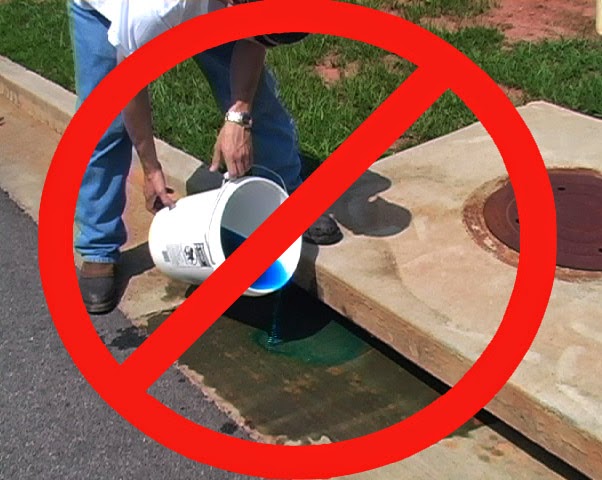
    You wouldn't pour this into a lake or creek, right?
    Storm drains are a direct connection from our streets to our local waters.

    Do you know that only storm water is legally allowed to go into the storm drain? Non-storm water discharge, also known as illicit discharge, causes water pollution by sending pollutants right into creeks, streams, ponds, and lakes. Do you know how to identify these activities so that you can prevent water pollution and help keep our water bodies clean?

    Your street is directly connected to a lake or stream.
    Stormwater (and anything else dumped in the stormdrain)
    is piped into nearby water untreated.  Keep it clean!
    The public storm sewer system is designed to convey only storm water runoff to nearby bodies of water. The runoff does not go through any treatment before it empties into a receiving water. An illicit discharge is the discharge of pollutants or non-storm water materials into the storm sewer system via overland flow, direct dumping, or illicit connections. Illicit connections are pipes or other direct connections that illegally or unknowingly release pollutants or non-storm water materials into a storm sewer system or directly into a body of water. Dumping anything other than storm water into a storm drain allows pollutants to enter lakes and streams causing public health concerns, harm to wildlife, and unpleasant odors or color. Examples of illicit discharges include sanitary wastewater, commercial carwash water, septic tank effluent, inappropriate disposal of yard and pet waste, improper disposal of vehicle and toxic wastes including motor oil, pesticides, and paint.


    You may not always catch an illicit discharge as it is happening. Other things to look for include makeshift pipes or hoses that lead to a storm drain or water body, unusual odors accompanying any discharge, water flowing during dry times of the year, dead or distressed fish, plants, or other wildlife.

    You can reduce pollution entering the storm sewer by:
    • never dumping anything into a storm drain
    • taking your used oil to your local waste oil recycling site
    • disposing household hazardous wastes properly
    • bringing yard waste to your local compost site
    • discarding pet waste in a garbage can
    • washing your car on your lawn to allow excess water, chemicals, and dirt to be filtered through the grass
    • and dechlorinating pool water before draining 

    Additional information on disposal sites can be found at the Ramsey County Public Health website. http://www.co.ramsey.mn.us/PH/


    Certain types of water discharges are not considered illicit. These include water line flushing, air conditioning condensation, irrigation water, water from crawl space pumps, lawn watering, individual residential car washing, dechlorinated swimming pool discharges, and street wash water, discharges or flow from firefighting and other discharges that are necessary to protect public health and safety.


    If you see anything that could be considered an illicit discharge, call RWMWD at 651-792-7950. If it is a potentially hazardous spill, call the State Duty Officer at 651-649-5451.

    Whether there is a stencil there or not, the same is true.
    If you would like to help stencil to remind others, go to www.fmr.org.

    Nominations Sought For Watershed Excellence Awards 2014

    By Sage Passi


    Sherry Brooks received the 2013 Youth Engagement Award for her work with Farnsworth School.

    Ramsey-Washington Metro Watershed District is now accepting nominations for our 2014 Watershed Excellence Awards. The awards recognize individuals, organizations, government entities, businesses and agencies that have demonstrated outstanding achievements in water resources management, watershed stewardship and civic engagement. The purpose of this award program is to increase visibility and honor the accomplishments of exceptional “leaders” who participate in activities in a variety of contexts and levels of involvement within the district. The award ceremony will be held in late November.


    This year our Citizen Advisory Committee will be involved in supporting the review of nominations and helping select a design concept that will be used to create an artistic award to be given to each recipient. We have contacted several local artists to solicit design concepts and will be choosing one for reproduction.


    Last year's Watershed Excellence Award that was presented to each recipient.

    Please note that we are not limited to the six award categories listed below, although we will only be giving out a maximum of six awards each year. If you have a suggestion for another category and want to nominate someone in that category, please feel free to do so. We welcome and will consider these kinds of creative suggestions! 
     
    Nominations can be sent to Sage Passi, Watershed Education Specialist at sage.passi@rwmwd.org or by mail to Sage Passi, Ramsey-Washington Metro Watershed District, 2665 Noel Drive, Little Canada, MN, 55117. The nomination deadline is August 21. Please include the name of the nominee, the award category, your own name and contact information and a brief description of the nominee’s contribution or accomplishment in one of the following categories:

    Innovation in Government Award - Recognizes and celebrates excellence by a government agency in implementing innovative policies, programs or projects to protect and improve water quality within Ramsey-Washington Metro Watershed District.

    Outstanding Partner Award Recognizes an individual, group or business that effectively collaborates with Ramsey-Washington metro Watershed District to achieve exceptional results in water resources management and stewardship.

    Roger Lake Stewardship Excellence Award Recognizes an individual who has, during his or her lifetime, played a significant and long-term role in watershed management and demonstrated leadership in natural resources stewardship.


    Citizen Engagement Award Recognizes an individual or organization that effectively facilitated citizen participation efforts to improve and protect water quality.

    Youth Engagement Award Recognizes a teacher, youth organizer or organization that has demonstrated exceptional commitment and capacity to engage youth in watershed education and stewardship initiatives.

    The “Carpie” Award – Recognizes an individual(s) who have persevered very enthusiastically through the most trying of conditions while engaging in watershed and natural resource management in Ramsey-Washington Metro Watershed District. Please note: the title of this award may have a new “nickname” each year dependent upon on the type of activity involved. For example, the “Buckie” award for outstanding work in buckthorn removal.

    Click here for a summary of our 2013 winners.

    Tuesday, June 17, 2014

    “Water is Life” – a celebration of WaterFest in its Fifteenth Year


    Harding High Earth Club kicks off WaterFest 2014 wtih a ceremony to honor
    the many lakes, creeks and rivers in our watershed.
     
    By Sage Passi

     
    WaterFest, the Ramsey-Washington Metro Watershed District’s “event of the year,” held on May 31st at Lake Phalen, proved once again to be a kaleidoscope of many magic moments. This year we celebrated the fifteenth anniversary of this free public event which honors our clean lakes and provides outdoor fun and opportunities for hands-on learning about the water quality, wildlife, and special ecological features of our watershed.


    Shann Finwall, Environmental Planner for the City of Maplewood,
    captivates her audience while educating about protecting pollinators.
     
    There are many people and organizations who volunteer their time and energy to make this a successful day. It’s truly a grassroots community event, coordinated by consultant Debbie Meister with support from a cadre of many Watershed District staff, our Board of Managers and Citizen Advisory Committee members, students and teachers from local schools and the University of Minnesota, community volunteers, organizations, local businesses and the City of St. Paul who is a major sponsor and partner for this celebration. 

    Clockwise from top left: Families enjoyed quad bikes from Wheel Fun Rentals.  A girl gets a close up look at some of Maplewood Nature Center's live animals.  The MN Herpetological Society was a crowd favorite.  Katie Keefer, on the District's Citizen Advisory Committee (CAC) answers questions at the information tent.

    Coupling this event with the city of St. Paul’s sponsorship of the National Get Out-of-Doors Day has proven to be a charmed partnership that has helped this event grow in size and popularity over the past three years. Many local cities in the district in addition to St. Paul pitch in to help finance this event. Our many thanks to the hundreds of volunteers and visitors who made this annual event a big success!!!
     
     
    St. Paul's National Get Out-of-Doors Day included many fun activities including face painting, arts & crafts, a climbing wall, archery, a bounce castle and more.


    Matt Brickman with WCCO's Mobile Weather Watcher
    Of course it wouldn’t be a typical WaterFest celebration without some precipitation. Matt Brickman with WCCO’s Mobile Weather Watcher van was set up next to the Pavilion and provided up-to-the-minute weather reports to nearby exhibitors and curious visitors. True to character, this year’s WaterFest took place on a mostly pleasant late spring day with the repeated suspense of when the next downpour would hit. 


    But, the threat of inclement weather in the afternoon didn't seem to deter people for very long. Luckily the Water Is Life and waterfall dedication ceremonies had been carried out by noon so that each time after the brief rainstorms hit, the crowds came back, most exhibitors returned to their displays, visitors ventured out in Voyageur canoe rides or got on padelboards and took up the many other fun activities up and down the shoreline of Lake Phalen from the beach house to the Pavilion. 


    Left: This optimistic man's shirt says "Sunshine.'  Chalk drawings from The Friends of Swede Hollow got a
    fresh pallet after downpours.
    

    We knew there was a good crowd there - maybe one of the busiest yet - but we were delighted to get some final estimates of how many folks participated in the activities.  Check out some of the numbers and highlights:
     
    • Over 400 people paddled in the Voyageur canoes 
    • There were over 90 exhibits plus many other activities including displays by schools 
    • 519 people participated in St. Paul’s arts and crafts projects
    • Camille Gage, public artist and Romi Slowiak, Art in Swede Hollow organizer engaged participants in arts activities
    • Over 700 people got LEAP Frog tattoos
    • Solar pontoons provided non-stop rides for over 150 people
    • Access to stand-up paddleboards, canoes and kayaks was free at the beach area and busy all day.
    • About 200 people fished and/or participated in the fishing contests
    • 40 people participated in geocaching and spent an average of an hour in this activity


    The theme of WaterFest 2014 was Water is Life.  Performances by students from Harding High School, St. Peter and Farnsworth Schools and the Farnsworth marching band (200+ students in the band alone!) reflected this theme during the dedication and turning-on of the restored waterfall on the west side of Lake Phalen.  Thank you to Bryan Murphy, St. Paul Landscape Architect for restoring the waterfall!

    Top left: The waterfall on the northwest shore of Lake Phalen, created in the 1950s, had been dry for decades.
    Top right: The crowd gathers and waits for the waterfall to be turned on.
    Bottom: Farnsworth Aerospace marching band fills the amphitheater.
     

    There were many other activities in the pavilion, around the pavilion, at the beach house and all the way down to the beach.  Here are a few more shots:
    Left: Stormdrain Goalie game by Hamline University's CGEE.
    Right: Dean Hansen's macroinvertebrate display gets more interesting every year.

    Left: Kids got up close and personal with Dean Hansen's macroinvertebrate display.
    Right: Artwork, science projects, local organizations, and lots and lots of delighted guests.

     
    Left: Harding High School Earth Club volunteer helps a visitor mix up her own non-toxic cleaner to take home.
    Right: RWMWD's displays attract all ages.
    Exhibitors and guests fill the paths at WaterFest 2014.

    
    Lee & Rose Warner Nature Center host solar pontoon rides.
    The musician for the Waterfall Dedication ceremony, Don Rose, was canoed in from
    the beach by Randee and John Edmundson.

    Sage Passi (blue shirt) and Bev Blomgren (holding blue scarves), the creative minds behind
    the Waterfall Dedication program stand with St. Peter School Poets.  Also pictured, Don Rose, musician for the program.

    The MN Pollution Control Agency's Permeability Plunco had a steady stream of interested kids and adults.

    Project WET use fish stamping to teach kids about native fish species.

    SCM Yoga LLC hosted free classes near the boat house.

    St. Paul Public Works brought their street sweeper to give visitors an up-close view.

    MN Stand Up Paddleboarders Association gave free lessons and use of equipment.

    Vertical Endeavors exhibitor promoting membership for year-round climbing.


    Wilderness Inquiry & Voyageur Canoes take a rain break while visitors goof around while they wait.

    The Stormdrain Goalie air hockey game (Hamline CGEE) was a big hit, especially during downpours.


    Rice Creek Watershed District's Stormwater Putt Putt golf was far more challenging than it looks!

    Wilderness Inquiry staff shows visitors the proper way to hold a canoe paddle.

    Hmong Outdoor Enthusiasts provide fishing poles, lessons and co-sponsor the fishing contest.

    WaterFest is an opportunity for people of all ages to learn by doing, hear from experts, play a little, stretch, eat some yummy food and join the Watershed community to celebrate the web of relationships we have to water.  Were you there?  Did you see yourself in the photos above? What was your favorite part?  We welcome your comments and discussion below.


    Photos by Anita Jader, Sage Passi, and Carrie Magnuson


    Keller Golf Course- The Preferred Oasis for Golfers, Birds, Bees, Butterflies and Golf Ball Scavengers

    Farnsworth 5th-graders at Keller Golf Course
    Farnsworth fifth-graders show off their discovered "trophies" after pitching in
    to help with the restoration mid-May.

    If you want to see dramatic contrasts between landscapes, experience nature in its prime, learn about biodiversity, bird watch while swinging those irons and stroll while you roll, Keller Golf Course is the place to go.

    
    The perfect spring day at Keller Golf Course.
    The perfect spring day at Keller Golf Course.
    Transformations, in progress for several years during the restoration, have created a unique atmosphere on the golf course. The course has yet to open officially after a two year hiatus during its renovation, but the compliments keep rolling in from visitors who have had a sneak preview. Chat amongst yourselves because there’ is a lot to talk up and celebrate. Even the Baltimore orioles were very conversive when we were planting with our student volunteers at the golf course this spring. This is year two of an intensive Watershed District partnership restoration grant project. With help from Ramsey Conservation District, Natural Resources staff has been very engaged in restoring a variety of habitats and creating buffers in no-play areas within the site.

    Bill Bartodziej and Ramsey County Corrections crew prepare a buffer area for planting.

    While prepping a group of fifth graders from Farnsworth during a series of three days of planting, we discovered a hill with beehives near our restoration site. That’s the kind of surprise that is inevitable on such a diverse site. There’s plenty to talk about at Keller Golf Course, but that unexpected opportunity provided a perfect teachable moment to pontificate about pollinators, neonicotinoids and our threatened food resources. And we didn’t have to go more than 50 feet! That’s pure heaven for Master Gardeners who have been assisting the Watershed District and providing educational support for many years on restoration projects like this.
    

    Left: Krogh's class plants on a steep incline at the golf course to slow erosion.
    Right: Jaci Krogh (holding the props for her class's performance at Phalen Lake for
    WaterFest 2014) is a St. Peter's teacher who has a fondness for Keller Golf Course that
    dates back to her childhood.  Protecting the water of nearby lakes has been a theme
    all year for her students.
    Years ago, Keller Golf Course was a winter playground for Jaci Krogh, a teacher at St. Peter School when she was growing up. She spent lots of time in the area, sledding and hiking. Her nostalgia for the lay of the land and connection to its nearby lakes, I would venture to guess, played a significant role in her decision to involve her class in a year-long project on water this year. Her students wrote poetry and created performances for both a Maplewood Mall art dedication and WaterFest. It only seemed natural to invite her class to be part of the restoration this year, given her long-time relationship to the area. Her class, along with Mitch Thomsen’s three high school classes from Mounds Park Academy and four fifth grade classrooms from Farnsworth Aerospace were the teams this year that helped plant 2600 native plants this spring on the course.

    
    Betsy McNulty, Ramsey County Master Gardener, assists a
    Farnsworth student during the restoration of this low-lying area.

     
    So what’s behind the efforts at Keller Golf Course these days?


    RWMWD Natural Resources Technician, Simba Blood, orients students about planting native plugs.

    Bill Bartodziej, Watershed District Natural Resources Manager, Simba Blood, Natural Resources Technician and her interns, Jake Lindeman and Zola Pineles have been knee deep in projects out at the site since the snow melted this spring. Wasn’t that just yesterday? So I asked Bill to make it short and sweet and narrow it down to five bullet points to cover the highlights of the project.
     
    Here’s how Bill summarized it:

    • We are addressing the restoration of 7.5 acres of prairie, wetland buffer, and connected woodlands.

    • Buffers help treat water before running into wetlands and Lake Keller. Large prairie areas reduce run-off and create exceptional habitat. Over 100 native plant species are being introduced into the restoration areas.

    • Keller Golf Course is in the Phalen corridor and is directly connected to county park natural areas.

    • We look at the natural areas in the golf course almost as a preserve. These areas are less disturbed by humans, compared to the adjacent parklands. (A practical example is that colorful forb species are not dug up by plant thieves, like we have seen at Lake Phalen. Also, trampling by foot traffic will be less evident.)

    • This project is a win-win for all of the partners. Golfers are able to experience incredible natural areas in the city. Educational signs will help golfers understand key habitat areas. Water runoff will be reduced. Biological diversity will increase. Quality habitat in the Phalen corridor will substantially increase.
    That's a lot to feel good about!

    A natural team - Paul Diegnau, Superintendent at Keller Golf Course, and
    Bill Bartodziej at home in a golf cart at WaterFest 2014.