Showing posts with label Carp. Show all posts

Tuesday, March 28, 2017

Finding Value in Our Healthy Shallow Lakes

By Bill Bartodziej, Natural Resources Specialist

Going up to "the lake" is a Minnesota tradition.

Lakes up north

It’s a flawless summer morning – light breeze, sun is rising, and the temperature is a perfect 70 degrees. We pack the SUV full of floaties, sun screen, fishing rods and swim suits. We program our favorite music playlist for the road trip and then set course for “up north”. Getting away from the city bustle and spending a few weekends on north-country lakes is a tradition that’s in our blood; it’s just the Minnesota way.


Lake Superior
Photo credit: Rosanna Imholte

So what do you think makes the ideal lake? Some descriptors that are often associated with high quality lakes are: clean, clear, weed-free, deep, good fishing, sandy beaches, blue water, panoramic views and secluded. Not that we ever brag, but Minnesota does have the most lakes (11,842, actually) in the contiguous United States. Lakes vary quite a bit, depending on where they are located in the state and how deep they get.

Generally, the lakes that we have up north are quite different from the lakes that we find in the Twin Cities area. This mainly has to do with geology and watershed type. Northern lakes are often formed by depressions in granite bedrock, with their watersheds being dominated by forest cover. This combination usually harbors lakes that are low in nutrients, clear and deep, with minimal aquatic plant growth.


Casey Lake in a clear-water state
Urban lakes

In our urban watershed, we have a mix of relatively deep and shallow lakes. Rich soils and storm water runoff contribute to our local lakes being higher in nutrients compared to the lakes that we visit up north. Our local lakes are generally more “productive”, meaning that they support more plant growth. Free floating algae, cattail, lily and submersed rooted species take advantage of the nutrients in our urban lakes and become well established. 


Casey Lake in murky-water, algae-dominated state

Usually, shallow lakes (less than twelve feet) are found in one of two completely different states: a murky-water, algae dominated state (poor quality) and a clear-water, plant dominated state (healthy or high quality). It is uncommon to find shallow lakes that are in the middle, with moderate algae and rooted aquatic plant growth, for a long period of time – say several years. Watershed management works to reduce nutrient inputs to our lakes and to improve water quality.


Native aquatic plants growing in a clear lake.

Shallow lakes with good water quality support lush rooted aquatic plant growth. This is natural, healthy and a normal condition for shallow lakes. But, this concept is not all that intuitive. Shallow lakes are often misunderstood. Abundant plant growth tends to work against the thought of what an “ideal” or high quality lake is all about. 


Our vision of clear, deep northern Minnesota lakes can distort our expectations for our urban lakes. This is especially true with shallow lakes and ponds in our urban watershed. Some use northern Minnesota lakes as a gauge to define how a healthy shallow lake should behave. But not all lakes are created equal, and making direct comparisons between deep and shallow lakes is not advised. This would be analogous to a doctor using a health chart of a six foot male to assess the condition of a five foot female. This examination would obviously be flawed and lead to misdiagnosis.


What we value

In many cultures and places around the world, the clear-water, plant dominated state of shallow lakes is widely accepted and highly desirable. For instance, in Europe and Japan, turbid lakes are turned to clear-water, plant dominated lakes, and this is considered very successful lake management. From a conservation standpoint, their citizens would be upset by the thought of doing anything to impede aquatic plant growth in these lake systems.* But for some reason, our Minnesota cultural heritage seemed to generally miss the important lesson that “healthy shallow lakes grow a lot of plants”. Good water quality promotes a robust aquatic plant community.

So what makes aquatic plants so important in shallow lake systems? A majority of the healthy shallow lakes in our watershed support over ten native submersed plant species. This plant community can be thought of as the underwater forests of our lake systems. Aquatic plants provide food and shelter for wide variety of aquatic insects. This underwater cover creates excellent game fish habitat for species such as largemouth bass, bluegill and northern pike. Rooted plants hold lake-bottom soils in place which limits “turbidity” or particles being suspended in the water column. Aquatic plants also provide a surface or substrate for algae to grow. These algae take nutrients from the water and can lower the nutrients that are available to free-floating algae. This competition for nutrients lowers the risk of substantial algal blooms, especially in the hot summer months. This relationship helps to perpetuate the clear-water state in shallow lakes.


Watershed management and shallow lakes

Our Watershed District implements intensive lake and watershed management projects to reduce nutrient inputs to our lakes. Our activities are directed by federal and state water quality laws. Over the last few years, through this work, two shallow lakes in our watershed, Kohlman and Casey Lakes, have seen dramatic improvements in water quality. These lakes are now in a clear-water state. The changes that have occurred have brought about many discussions with citizens concerning lake use, aesthetics and the value of aquatic plants. The conflict really boils down to how shoreland owners use and view the lake. From water quality and biological diversity standpoints, watershed management is a huge success, but from a recreational use standpoint, management has failed. 


Casey Lake before the shoreline restoration and
carp removal was complete.


Most often, people that move around on the water with speed would like healthy shallow lakes to act like deep lakes. This means clear water and very limited plant growth in the center of the lakes. However, a shallow lake with clear water will support lush rooted plant growth throughout the entire lake. The extent of the plant growth is really the crux of the problem. Surfaced plants do not mix well with water skiing and pleasure boating. Deep water lakes have large expanses of open-water throughout summer, but healthy urban shallow lakes often do not. In addition, many shoreland owners view surfaced aquatic plants as “weedy” and “unsightly”.


Sharing information

Maybe in a perfect world, with knowledge and exposure to a different point of view, affected lake users would quickly embrace the idea that abundant plant growth is an essential component in healthy shallow lakes. They would realize that this response is the direct result of improved lake water quality, which substantially benefits our watershed community as a whole. However, in reality, it will take time to share knowledge and educate residents on healthy shallow lakes and how they differ from our deep lakes. Maybe, over a period of years, we will see the intrinsic value of healthy shallow lakes go up.

This summer, to begin to address this important educational need, watershed staff and our Citizen Advisory Commission will be working on the production of a shallow lakes educational video. We are happy to have videographer Ben Hansen lead our team on this effort. You may remember the video Ben helped us produce about six years ago about the common carp in the Phalen Chain. It was a great educational tool that highlighted cutting-edge research and management. It can be found at this this LINK.

There really isn’t a video about shallow lakes like this available locally or nationally, so we see this benefiting our watershed, and potentially having impact on a regional and maybe even a national level. We will be shooting video on Kohlman, Casey, Bennett and possibly other shallow lakes in our watershed. We hope to incorporate some aerial and underwater footage in order to make this video product unique and inspiring.


You can help!

If you run across something interesting on a local shallow lake this summer, please let us know! We may be able to get a camera out quickly to film some footage. The plan is to have the shallow lakes video available on You Tube and shorter clips showing up on Instagram and Facebook. Please stay tuned and be on the lookout for a cool video highlighting your healthy shallow lakes this fall.


*Citation: Cooke, D.G., P. Lombardo, and C. Brant. 2001. Shallow and Deep Lakes: Determining Successful Management Options. Lakeline (North American Lake Management Society) 21: 42–46.
 
 
 Boundary Waters Canoe Area sunset.
Photo credit: Rosanna Imholte


Thursday, November 10, 2016

Big Yellow Excavators Improve Local Fishery

By Bill Bartodziej


How can big yellow excavators improve a local fishery and create a safeguard against carp in the Phalen Chain of Lakes?

Let’s back up before we answer this question.

Markham Pond is at the headwaters of the Phalen Chain of Lakes and drains into Kohlman Creek, which feeds Lake Kohlman. About six years ago, Markham Pond was identified as a carp nursery area. Thousands of carp, young and old, had the ability to migrate down into and infest the main lakes in the Phalen Chain. Carp are bottom feeders that stir up sediments, release nutrients and can negatively impact water quality. 


Markham Pond is a shallow system, with a maximum depth of four feet. During harsh winters, it’s likely that game fish species, like bluegill sunfish and largemouth bass, froze out and died. However, carp are a very resilient species and can handle winter conditions in shallow lakes and ponds.

Over the last couple of winters, Markham Pond was drawn down (or drained) in order to manage the carp population. This year, summer sampling in the pond revealed a few native fish species, like minnows, green sunfish, and bullhead, but no common carp. 
We took that as a sign that we were successful in significantly reducing carp and eliminating this threat to the Phalen Chain of Lakes.

University of Minnesota Carp Research Team
netting carp on Markham Pond
So the bad guys that threaten water quality are gone, end of story, right?

Wrong. Carp are stealthy and reproduce like crazy, and have to potential to explode in Markham again. What can we do to naturally control carp in Markham? The surprising solution was actually discovered in our watershed by the University of Minnesota’s Carp Research Team; bluegill sunfish zealously consume carp eggs, acting as a biological control mechanism. Carp have a very difficult time successfully reproducing in lake and pond systems with high bluegill populations. Thus, reintroducing a healthy bluegill population in Markham Pond will create a safeguard against the re-establishment of a substantial carp population.  
 
Bluegill's appetite for carp eggs should keep the carp population in check.

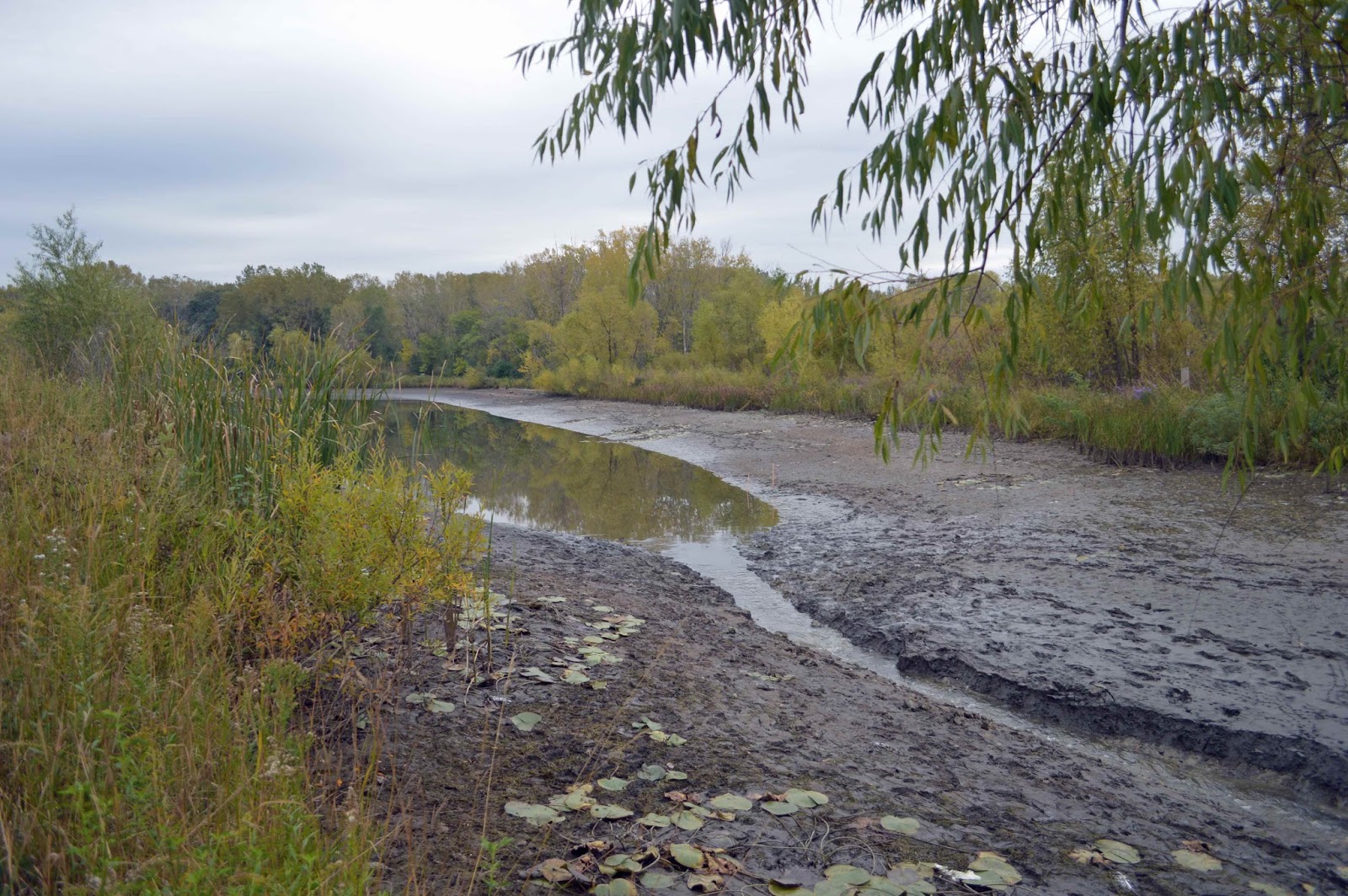
So how do we improve habitat for bluegill sunfish and other game fish in Markham Pond and help them survive the winter? A reasonable approach is to create a deep water refuge by excavating a wide and deep hole for game fish to hunker down in during the cold months. This fall the watershed is in the process of drawing down the pond by opening up a water control structure. A dry pond bottom will make it easier for excavators and earth moving equipment to do their work this winter.


The Plan
 
Pond levels are down as we intentionally lower
the lake level in anticipation of construction.

During January and February, we plan to remove accumulated sediment that has washed into the pond and create a fourteen foot deep refuge almost an acre in size. A grant from the Minnesota Pollution Control Agency will help support this work. The paved parking lot at the north end of Hazelwood Park will be used as the construction site entrance and equipment staging area.


Next spring, the pond will be filled back up again and the watershed will work with the DNR to stock game fish species. This deeper refuge area will not freeze to the bottom, even during harsh winters, and will have suitable dissolved oxygen levels for game fish.

Additional benefits of the project will include increased recreational fishing opportunities, robust aquatic plant growth, enhancement of wildlife habitat, reduced pond bottom re-suspension from carp activities and, hence, improved water quality in Markham Pond and downstream waters in the Phalen Chain of Lakes.

So when you drive by Markham Pond this winter and see big yellow backhoes digging away, be assured that this work will help to improve our fisheries and preserve the water quality in the Phalen Chain of Lakes.

Monday, October 12, 2015

Carp Talk – Keeping Tabs on Carp in the Phalen Chain

Jordan Wein measures carp caught in Kohlman Lake box nets.
Photo credit: Anita Jader

By Bill Bartodziej

Over the last six years, we have made substantial progress in understanding the common carp population and ecology in the Phalen Chain of Lakes. We have learned that carp densities over 90 pounds per acre typically result in negative impacts to lake water quality. This has become our long-term carp management target. 

We also discovered that carp actively spawn in the main lakes, but bluegill sunfish consume most of their eggs. However, adult carp in small lakes, ponds, and connecting wetlands can be very successful in producing young carp if bluegill are absent. So if we want to keep carp at low levels in the main Chain of Lakes, we must turn to managing these small connected waters. 

We have located the key spawning areas that are connected to the Chain and have been actively working to eliminate the juvenile carp in these systems (e.g., Casey Lake, Markham Pond, Owasso Basin, and Kohlman Basin).
This map shows key targeted areas in the Phalen Chain where carp management
has been in progress in the past few years.

This year the Watershed District contracted with Carp Solutions, LLC, to conduct carp survey work in connecting ponds and small lakes and to trap adult carp in the main Chain of Lakes. District Natural Resources staff have been working closely with Dr. Przemek Bajer of Carp Solutions and his staff. This effort is progressing very nicely and the results have been encouraging.


Adult Carp Management
 

We will continue to reduce the adult population in the main Chain of Lakes over the next several years. At the beginning of this year, we estimated that there were 2,900 adult carp remaining in the Phalen Chain. Through summer box-netting (images below), we have been able to remove 500 carp to date. This is over 17% of the remaining adult carp population. Although this not glamorous work, summer box-netting has proven to be a very useful carp management tool. For the purpose of systematically reducing the carp population at a reasonable cost, this seems to be the most effective tool at this time.


Over the last several years, we have reduced the adult carp density by over 60 percent, from 158 pounds per acre to 55 pounds per acre (average biomass for Kohlman, Gervais and Keller Lakes). We are now well under our 90 pound per acre management goal. The captured carp are making their way to the Ramsey County Correctional Facility greenhouse where compost is being produced. A good portion of this compost material will be used to grow native plants at the nursery.


Cracked corn is used to attract carp into the box nets. Natural Resources Technician, Simba Blood,
and interns, Thea Evans (left) and Carrie Taylor (right), bait trap nets.


In addition to being an effective tool in carp removal, the box netting effort suggests that young carp are not common in the Phalen Chain. So far we have not captured a juvenile carp in the netting operation. All the fish have been big adults. These results support the idea that substantial carp recruitment (young fish moving into the adult population) has not taken place in 2014-15 in the main Chain of Lakes. This is very good news!


Herding captured carp into the corner of the box net for removal.

Keeping Tabs on the Nursery Areas


Trap nets were set to capture small fish in carp nursery areas in the northern part of watershed. Good news! No young carp were sampled in Markham Pond, Casey Lake and Willow Lake. Additionally, other survey work suggests the absence of adult carp in these systems. This confirms that we are making progress in effectively managing these systems and eliminating the threat of large numbers of juvenile carp moving into the Chain.

Trap nets set in Markham Pond. No carp were found.

Kohlman Basin Management

Kohlman Basin is a ponding and storm water treatment area that receives water from Willow and Kohlman Creeks; water exits and makes it way to Kohlman Lake. The main basin is located on the south side of Beam Avenue between Highway 61 and Hazelwood Street across from Costco. Previous survey work (Justine Koch’s thesis study, U of MN) suggested that there were a few hundred adult carp, and surprisingly, some gamefish in this Kohlman Basin system. 


The drawdown of Kohlman Basin, a wetland complex located along Beam Avenue in Maplewood.


This year, only one young carp was found in a small connecting wetland just to the north of Kohlman Basin (we did not survey for adults). Although only one juvenile carp was netted, this is an indication that carp are successfully reproducing in this system. Thus, this confirms the necessity to manage these systems to minimize the risk of a large year class of juvenile carp being produced.


Stephen Theis, RWMWD Natural Resources Intern,
sets up a net at Kohlman Basin outlet before the drawdown
.

On October 1st, watershed staff opened the outlet and began to draw down Kohlman Basin and the connecting wetlands to the north. Our main objective is to drain most of the water and then net carp in the remaining pool. We will preserve all the gamefish in the system. After our fall harvest, the outlet will be closed, and the basin will be filled before winter. We will certainly keep you updated on this carp management effort.


The drawdown of Kohlman Basin in progress. View is facing the outlet on the west side.


K
Keep your fingers crossed that the Kohlman Basin drawdown is successful. Rest assured our work with carp is not over yet. The Watershed District intends to comprehensively manage carp over the long-term in the Phalen Chain of Lakes. Stay tuned to your local dial for the next installment.

"Working on removing carp from the Phalen Chain of Lakes! This haul from Lake Gervais
was 46 adult carp, or as we prefer to think of it, 50 million future fish."

- Simba Blood, RWMWD Natural Resources Technician


“A scrapbook of carp photos isn’t complete without a shot of
Jordan Wein’s latest catch from a box net.”
   - Sage Passi

Thursday, May 14, 2015

Catching Up with Carp - Diving into the Next Phase

Carp catch from a large seining at Gervais Lake


As the saying goes, “We’ve come a long way, baby”, in understanding the role of carp in our local waters.

The Watershed District is shifting gears from research to a management and monitoring approach with the knowledge we’ve gained over the past six years. Who would ever have guessed that we would arrive at this step when we first ventured into this business of trying to understand and get a handle on carp?


University of Minnesota Carp Research Team members
measuring carp: Justine Koch (left), Dr. Przemek Bajer (center),
Dr. Peter Sorensen (right)    
Photo credit U of M

The common carp (Cyprinus carpio) is a non-native invasive fish species to Minnesota. It is a long-lived fish (over 60 years) that is now prevalent in most metro area lakes. They are intelligent creatures with a voracious knack for survival. 


University of MN Professor Dr. Peter Sorensen
“Carp are smart and they understand the topography between the lakes. One of the things we’re learning is they will overwinter in the deep-well oxygenated lakes. They aggregate in these places and then migrate in the spring to spawn in upstream small wetland “nurseries” where native fish have a hard time surviving because of lowered levels of dissolved oxygen in the water.” - Dr. Peter Sorensen, University of Minnesota


Carp root around in lake and pond bottoms for food. They hunt down aquatic invertebrates, seeds, and other plant parts. This activity, along with carps’ excretion of nutrients, can have negative impacts on lake water quality and aquatic plant communities. Carp densities over 90 pounds per acre typically result in negative impacts to lake systems.

 
Kohlman Lake
Photo credit Anita Jader

What are those negative impacts? When carp stir up the bottom of a lake or pond, phosphorus from those bottom sediments can be re-suspended in the water column. This disturbance increases this nutrient’s availability to aquatic plants and algae leading to underwater plant population spikes and algae blooms. Water clarity decreases.


Algae bloom in Casey Lake in North St. Paul
during the 2007 Shoreline Restoration


As the summer season moves along, bacteria use dissolved oxygen to break
down those
decomposing plants and algae. Dissolved oxygen levels drop, impacting native fish, macroinvertebrate and other aquatic populations that need higher levels of dissolved oxygen for spawning, reproduction and survival.


What has been the Watershed District’s involvement in carp research and management in the past six years?

U of MN Carp Research Team using electro-shock boat


In 2009, the Watershed partnered with the University of Minnesota’s Sorensen Lab on an applied research project to investigate carp in the Phalen Chain of Lakes. The main objectives were to: 1) determine the abundance of carp; 2) identify spawning areas; and better understand what influences carp recruitment (maturing from an egg to an adult). The watershed funded this work along with the Legislative-Citizen Commission on Minnesota Resources (LCCMR).

Casey Lake had a very large population of juvenile carp before management strategies were implemented in the last couple of years.

Over the last six years, we have made substantial progress in understanding the carp population and ecology in the Phalen Chain. Through research and management, we have reduced the adult carp density by over 60 percent, from 158 pounds per acre to 55 pounds per acre (average biomass for Kohlman, Gervais and Keller). We have located the key spawning areas in the Chain and are actively working to eliminate the juvenile carp in these systems (e.g., Casey Lake, Markham Pond and Kohlman Basin).


Bill Bartodziej,District Natural Resources Specialist,
examines juvenile carp caught in a trap at Markham Pond.


A carp barrier was installed in Kohlman Creek to keep adult carp from migrating upstream to spawn in shallow lakes and wetlands.
 

What are the latest plans for controlling carp in the Phalen Chain of Lakes?

Emptying catch from box net trap


The Watershed will be working with a new company called Carp Solutions, LLC to continue adult carp removal on a limited basis and to monitor juvenile carp nursery areas. 


Dr. Przemek Bajer


Dr. Przemek Bajer, who worked with Dr. Sorensen, has started this company in order to provide  technical support to agencies that are managing carp on a large scale. These management services are not available through the University of Minnesota. The new Aquatic Invasive Species Center at the U of MN will only focus on research.

Natural resources staff will be working closely with Przemek and his staff to trap adult carp and to collect and process monitoring data. This effort is critical in continuing to manage carp in the Phalen Chain.


Scope of work – Summer 2015

Conduct adult carp removal in Kohlman Lake


Setting up a box net

Because of its small size and shallow depth, Kohlman Lake is especially well suited for the summer removal of adult carp to reduce their biomass in the Keller-Gervais-Kohlman system. District staff will place three box nets (30 x 30 feet) each in a different area of Kohlman Lake in August. Each net will be baited with dry corn for approximately 7-10 days to train carp to aggregate at the bait (Bajer et al. 2010). 


A box net like this one will be used on Kohlman Lake
Once corn consumption is steady, they will lift the trap early in the morning when most carp are attracted to the bait, to capture and remove them. The process will then be repeated at least one more time, involving approximately one week of baiting to attract new fish. The exact protocol will be modified depending on the behavior of the carp.

Watershed staff will help with routine baiting and check-up. Captured carp will be counted and measured for length. Their number will be subtracted from the most recent population estimate to determine the biomass of carp that remains in the lake.

Conduct surveys of potential nursery areas for age-0 carp

These surveys will be conducted in lakes Casey, Markham, Kohlman Basin, the three Owasso Basins and Willow Lake. In each lake we will set five small-mesh trap nets (Bajer et al. 2012). The nets will be set for one 24-hour period in September 2015. Captured carp will be counted and measured and the catch rate of age-0 carp will be estimated based on length structure of collected carp. While conducting these surveys, they will also record catch rates and lengths of native fish.


Modeling different management strategies for carp in Phalen Chain to guide future management

Because common carp are not damaging at low densities, aggressive efforts to suppress their populations to extremely low levels are often unnecessary and expensive. Robust population dynamics models can be used to guide carp management efforts so that management goals are met without incurring unnecessarily high costs and using most practical approaches. Alternative management scenarios can also be evaluated to develop long-term management plans.

We will modify an existing carp population dynamics model (Bajer et al. 2015). to mimic carp population dynamics in Phalen chain of Lakes. We will then use the model to evaluate the effectiveness of several plausible management strategies, including, winter seining, summer removal of adults with box net, suppression of recruitment in headwater lakes, and barriers to carp movement. Effectively processing new data will further shape the management efforts of the Watershed District.

Here are several videos that document some of the District’s efforts in carp research since 2009:
  1. The Carp Project Video - Part 1 CTV North Suburbs (2010)
  2. The Carp Project Video - Part 2 CTV North Suburbs (2010)
  3. Carp Harvest (GTN, Chuck Turning, producer)
  4. Environmental Carp Wars with Dr. Peter Sorenson, (GTN, Chuck Turning, producer)

We’ll keep you posted as time progresses in our on-going efforts to control carp in the Phalen Chain of Lakes. 


Thursday, December 18, 2014

Carp Research Wraps Up for the Holidays


By: Bill Bartodziej


The University of Minnesota research project on common carp in the Phalen Chain of Lakes is now complete. Key products from this effort:

  1. We reduced the adult carp population in the Chain by over 50% - down to 58 pounds per acre. This meets our goal of having the adult population under 90 pounds per acre where negative water quality impacts are evident.
  2. Carp spawn in the main lakes, but bluegill sunfish effectively eat carp eggs, and this limits the number of young carp being produced in the lakes.
  3. We found several carp nursery areas that drain into the Phalen Chain of Lakes (with thousands of young carp). Small carp from these systems can find their way into the Chain. These systems will be actively managed to eliminate carp over the next several years.
  4. Several science journal articles have been written on this work. Data is being shared with researchers and managers on an international level.    
 

Map showing carp nursery areas that drain into the Phalen Chain of Lakes. The red highlighted waters indicate carp nursery hot spots.  (YOY = Yong of Year Carp)


The U of MN research team and Watershed staff are in the process of finalizing a carp management plan for the Chain. This is a long-term plan with components that are already being carried out by Watershed staff. 


No Carp Netting this Year?

So although winter netting under the ice on Lake Gervais is exciting, fun, and full of the “wow” factor, we have come to the point where the adult carp population is at a relatively low level. Water quality impacts from a population this size is not a concern.

However, this doesn’t mean that our work is done. An extremely vital component in the carp management plan is to keep young carp from finding their way into the Chain’s main lakes. Thus, we are shifting our efforts and going after the young carp in the target nursery areas, specifically Casey Lake, Markham Pond, and the Interstate Ponds. This is less impressive work on the surface, but a very critical component in keeping carp levels low in the Phalen Chain. 


Casey Lake Management

Over the last couple of years, we have been able to eliminate carp in Casey Lake. This was identified as a carp nursery hot spot. We have worked with the DNR and the City of North St. Paul to stock bluegill, and aerate this system over the winter. This effort will have direct positive impacts on Casey’s fishery and water quality. At the same time, we eliminated a significant source of carp that were threatening the entire Chain. 


With the aeration system in place, open water can now be seen in the middle of Casey Lake - December 2014.


On Markham Pond

This winter, we are working to eliminate carp in Markham Pond. Under a DNR permit, we began a draw-down of the system this fall. We were able to lower the pond level by about three feet. The maximum depth of the pond is four feet, mainly by the west end near the pond outlet.


During one of our upcoming severe January or February arctic blasts, we plan to pump the remaining water (under the ice) out of Markham, with the goal of freezing out the deeper pockets. Carp taking refuge in these areas will likely be eliminated. Once all of the carp are gone, we will partner with DNR and the city to stock bluegill and install an aeration system. This will safeguard against a carp re-infestation.


Again, this is definitely not as interesting as pulling nets under the ice on Lake Gervais, but it is very important work that will have lasting benefits to the entire Chain of Lakes.


After the draw-down, a large school of carp taking refuge in a deeper spot in Markham Pond - November 2014.