Showing posts with label Staff Stories. Show all posts

Thursday, September 28, 2017

Teamwork and "autumn joy" - A winning combination

by Sage Passi

Lesley Perg, a new Ramsey County Master Gardener, assisted students
at Roseville Area Middle School (RAMS) rain garden this fall.


We are in the final phase of completing our Clean Water Legacy-funded school rain garden projects. Jumping into the thick of things on a blistery hot fall day might not be everybody’s cup-of-tea in the world of school gardening, but Lesley Perg, a Master Gardener who transferred to the Ramsey County program from California this summer, was “cool as a cucumber” as she supported her team of seventh graders as they planted gallons of ‘Hot Lips’ Pink Turtlehead in the middle of one of these large-scale rain garden plantings in late September. I marveled at her calmness and comfort level as she stepped down into the crowded center of the garden in this complex matrix of planting areas. This was her first experience volunteering with our watershed district.

Merlin Schlicting, Ramsey County Master Gardener, contemplated the arrangement
of feather reed grass in another tight planting area at Roseville Area Middle School.

Room to move was at a premium in many areas of the garden and the number of students wielding long-handled tools could have been a bit daunting. But neither issue seemed to rattle Lesley and when the day was done, I didn’t hear any real complaints. Well, maybe, only about the heat. The same was true for the other Master Gardeners who stepped up to the plate over the past two weeks during our fall projects at Roseville Area Middle School (RAMS) and Central Park Elementary.


Teamwork makes anything possible.


I think everyone involved felt like through our teamwork we truly accomplished something HUGE! And we did!


Fifth graders plant at Central Park Elementary rain garden.


Where was this satisfaction coming from that was shared by this team of Master Gardeners, a Master Water Steward, and District staff who helped out students and the teachers? It can be truly rewarding to assist kids who have never held a shovel before and witness their comfort and confidence grow as they try it out. Assisting these young gardeners in transforming the mulched spaces into vivid landscapes to help their downstream lakes was truly inspirational. Our excitement continued to linger in the air as we all dispersed, tired but fulfilled at the end of each of our days of planting. 


Dominique Guzman, Central Park 6th grade teacher, gave a
high five to one of his students after he completed planting several pots.


Stephanie Wang, Master Water Steward helped “tease” the roots
for the student she was assisting at Central Park.

This positive energy was accentuated by the arrival of the bees and butterflies who appeared moments after we secured the flowering plants like Fragrant Hyssop and Walkers Low Catmint in the ground. Chris O’Brien, our new communications staff person, even caught that on camera!


We had to problem solve to make these projects successful. I spent many days recruiting and scheduling Master Gardeners, measuring and laying out the planting areas, calculating the number of students we could fit into a plot and figuring out all the logistics. When the planting days arrived, everyone contributed to the whole process from helping shuttle and move plants around, orienting students about how to plant, filling and hauling water buckets, matching up mountains of gloves and pitching in to load up the stacks of tools, pails and other equipment into my car at the end of each day.


The morning calm before the storm. Gloves matched? Check.
Who is working where? Master Gardeners review their assignments. Check.

Watershed Project Manager Paige Ahlborg fills large barrels for watering. In addition, she did grant writing and reporting, communicated with contractors, reviewed bids, planted and so much more! Barr Engineering was responsible for the design and project management of all of our Clean Water Fund projects.

The real heroes were the kids who applied their own planting skills learned in their native countries, and the young people who stepped outside their comfort zone, got their shoes dirty and tried planting for the first time, then offered to plant a second pot. We were proud of each student for their accomplishments and the way they each “showed up."


Go TEAM Go! What a powerhouse of youth energy!

The sheer scale of these projects certainly made our work more challenging this year. Luckily most of the planting areas were amended with sand and compost, making it much easier dig than last fall at Maplewood Middle School where we had to cut through some very compacted berms. 


Nancy Berry, Ramsey County Master Gardener, guided students who were planting Autumn Joy Sedum on the hillside at Central Park Elementary. The bees love their flowers!

But the hardest challenge came from the weather. The temperatures hovered in the eighties and nineties for both weeks and the humidity was high. Thankfully fall has finally arrived for our next installment of projects coming up in October!

Kids cooled down after planting the rain garden at Central Park Elementary.

The District began developing these projects over three years ago when we applied for an accelerated implementation grant from the state to assess all our public school sites and prioritize locations for BMPs on their grounds. A couple years later we were awarded a Clean Water Legacy grant to implement six projects.


Last summer the first three rain gardens were installed and then planted in the fall by students in Maplewood and North St. Paul. This fall we worked with five classes at Central Park Elementary in Roseville and ten classes at RAMS to plant close to 800 gallon pots in these two rain gardens.


After two days we were down to the tenth class at Roseville Area Middle School!


First step, move the mulch. Second step, dig the dirt out.
Third step, pose for the camera.
 
Next month we will be cranking up that number to a “whopping” seventeen classrooms from Woodbury Elementary and Middle Schools that will be completing our final rain garden planting at their location over three days in early October. That project will involve 564 students. Watch for that story in an upcoming Ripple Effect.
 The photos below help paint the story of our efforts this fall.

Tracy Leavenworth demonstrates how to plant a pot of prairie dropseed
at Central Park Elementary. She provided instructions for all
of the classes the four days at each of the schools. No small feat!


Anthony Larson, Roseville Area Middle School science
teacher, advises his team of students.

Happiness written all over her face!

Thank you to everyone for a job well done! We are looking forward to seeing our rain gardens grow and thrive in the future.

Wednesday, August 16, 2017

Cherishing a Crown Jewel – Tamarack Nature Preserve

By Sage Passi
The July tour at Tamarack Nature Preserve attracted an enthusiastic crowd.
Photo Credit: Dana Boyle
 
Tamarack Nature Preserve, tucked between Valley Creek Road, Radio Drive and Bielenberg Drive in Woodbury, is one of the few remaining intact tamarack supporting wetlands in the Twin Cities area. There are thousands of acres of tamarack swamps up north, but very few exist this far south. It’s become a favorite hiking destination for neighborhood walkers, birdwatchers, nature lovers and avid plant IDers.


Anna Barker, Washington County Master Gardener and Master
Water Steward, shares her knowledge about plants on the summer tour.


The last public tour the Watershed District co-hosted in the preserve with the city of Woodbury was in 2013. Thanks to the encouragement and work of Tamarack Nature Preserve advocates, Dana Boyle and Stephanie Wang, the wheels began to turn again this spring to host another tour for the public in mid-summer to raise interest and appreciation for this “crown jewel” of wetlands. 

“We are working on a broad community engagement plan to help residents learn about opportunities throughout the year to tour the Preserve, help with trail management (buckthorn and burdock removal and trash cleanups) and become better educated about this amazing treasure in our own backyard,” announced Dana and Stephanie who live in neighborhoods adjacent to the preserve. 

Last year Dana created an online field guide that highlights the diverse plant life abounding in the Preserve. Click here for the guide


The sensitive fern, found along the boardwalk in the Preserve, Onoclea sensibilis,
gets its species name from how quickly the leaves die back after the first frost.
 Photo credit: Dana Boyle


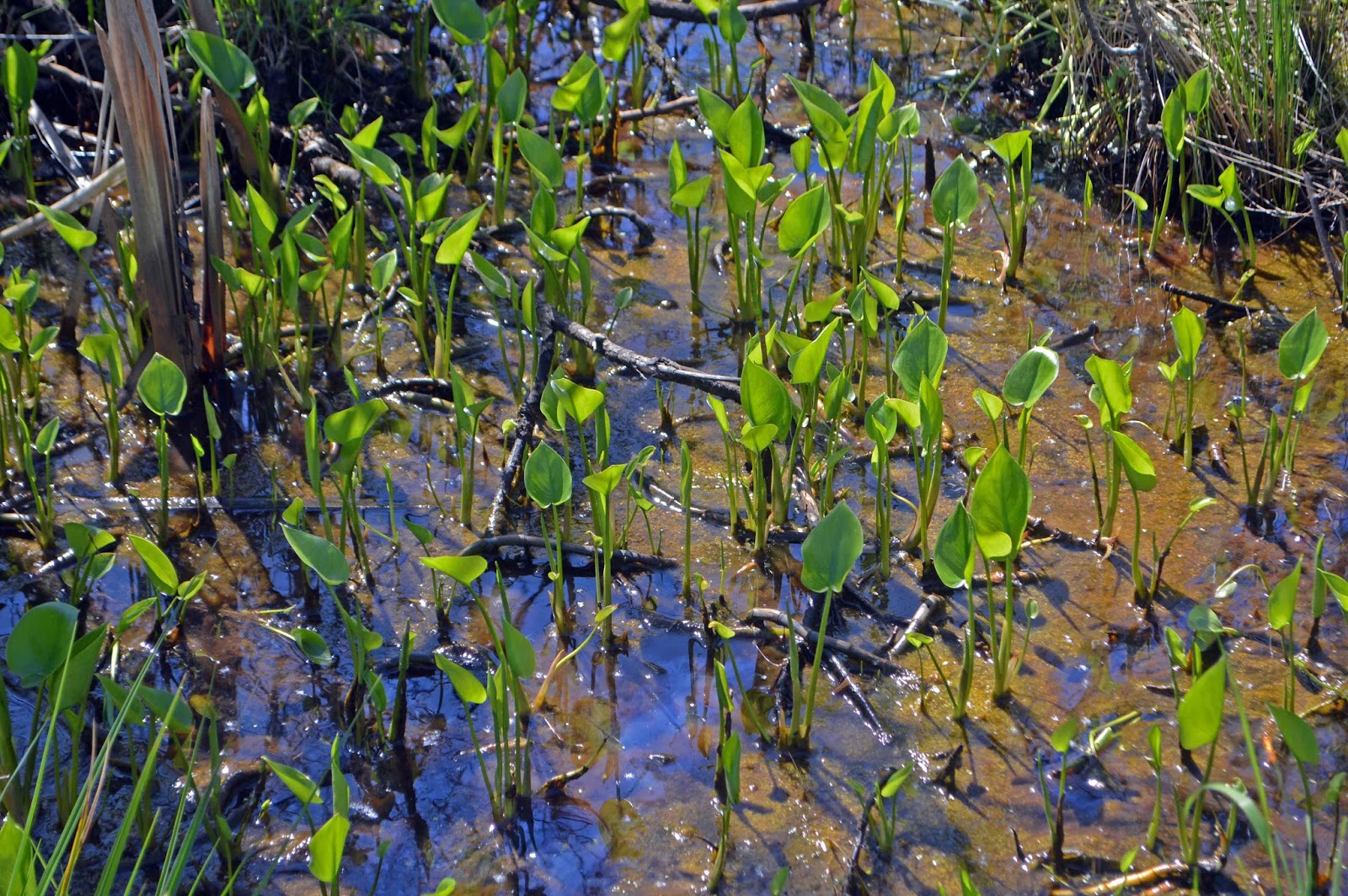
Bog aurum, also known as water arum or wild calla, is prolific in the Preserve.
Photo Credit: Sage Passi
 
This summer, Dana and her colleagues created a crowd-sourced “project” for the Tamarack Nature Preserve on the iNaturalist app to complete their capstone requirements for the Master Naturalist program. This interactive field guide is for people of all ages and interest levels to gain an appreciation for nature, specifically this Minnesota wetland, and to collaborate in order to become part of a community of friends of the Preserve.


 Broadleaf Arrowhead in bloom in the Preserve
Photo Credit: Dana Boyle


The guide currently features plants that are found in the fen (a bog trail) and on its perimeter (a woodland trail). It will also include birds, mammals, reptiles, amphibians and insects. Anyone who visits the area is invited to add their observations to this project. Over time they will have a record of phenology and see when and where these observations are most likely to be found. Here is a link.


Left to right: Dana Boyle, Kevin Burshten, Amy Howard, Kristin Seaman and Stephanie Wang trek through the Preserve. 


In preparation for the summer tour, Dana and Stephanie organized a reconnaissance walk in May with Woodbury Assistant Park Supervisors, Amy Howard and Kevin Burshten and Woodbury’s Environmental Resources Specialist Kristin Seaman to look for long and short-term solutions that would address trail issues in the park.

A reoccurring challenge in the preserve is a stretch of the path on the north side of the preserve that becomes very muddy and impassable in the spring and summer. They were also scouting for locations where invasive species could be removed by volunteers.


A stretch of the path in the Preserve that is hard to cross during parts of the year.
As a short term solution Woodbury park staff built a temporary boardwalk over the areas that typically flood so that the upcoming tour participants and others using the park could pass on the north side of the trail between the two main boardwalks.

A temporary boardwalk helps hikers
pass over muddy areas of the trail.

Both Dana and Stephanie have also organized several ad hoc invasive plant removal activities and are planning an educational event in August with a Woodbury Pack 60 Webelos Cub Scout Den who will be cutting back burdock on the north stretch of the trail between the boardwalks and touring the preserve.


Researching Tamarack Swamp’s recent past

Stephanie wanted to learn more about the history of the preserve so she approached Steve Kernik, a retired environmental planner for the City of Woodbury who provided this historical background about the area. 

"The Tamarack Swamp used to be an unbroken system starting at the back of City Hall and flowing downhill all the way to Battle Creek Lake. Over the years it got severed by Valley Creek Road, Bielenberg Drive, I-494 and Weir Drive. Valley Creek Road impacted the upper part of the swamp behind City Hall because the culverts under the road were set too high, which resulted in permanent high water that changed the character to a normal swamp.

About ten years ago a lift station was installed (mainly for stormwater management purposes) which keeps the fluctuations down, but the damage is done. From Valley Creek Road to Bielenberg Drive the swamp is fairly flat, dropping only a few feet. West of Bielenberg Drive it drops quite quickly, about 30 feet from Bielenberg to I-494. So the swamp west of Bielenberg is somewhat drier than the east side just because of topography."


Studies Completed in the Preserve

"There have been a number of studies done on the swamp, some of them dating back to the late 1970's or early 1980's. The really early ones aren't very detailed but the last one (or ones), done by the Ramsey-Washington Metro Watershed District are the most valuable. A detailed study of the vegetation of the swamp was done in 1999 that includes a map that shows the major ecosystems that are present.” 


This map delineates the location of different plant communities in the Preserve and its walking paths.
(Click on map for larger image.)
 
Kernik continued his recollections. "One of the interesting findings of that study was that all of the tamarack trees in the swamp are about the same age. They all got their start during the drought years of the 1930's. The assumption is that conditions were good for the tamaracks to germinate at that time, and as water started to rise in subsequent years, the trees were able to grow new roots just at the water line, which allowed the trees to survive in the deeper water. The problem is that young tamaracks can't germinate in the high water conditions.
One of the tamaracks that towers above the Preserve.


The District did a study of the high water which determined that it was caused by high groundwater, not surface water inputs. They examined what it would take to lower the groundwater through drain tile but determined that the damage caused by installing the tile would basically destroy the areas that we would be trying to save. So the high groundwater is just a fact of life. 

The other factor affecting the Tamarack Swamp is water quality. Tamaracks and the associated ecosystem usually exist in very low nutrient waters. It's not that they can't handle higher nutrient loads, it's just that other plants begin to outcompete them when nutrient levels rise. So this has affected the presence of other species moving in to the swamp."

To decrease stormwater runoff impacts the Watershed District installed two treatments systems in 1999 to capture sediment and contaminants entering the wetland. In 2003 the District designed a series of swales and basins, located along Valley Creek Road in Woodbury to treat stormwater before it enters the Preserve. 


The treatment systems on the edge of Tamarack Nature Preserve are pond-like with a brick bottom porous enough to allow some water infiltration, but hard enough to support a bobcat for sediment removal.


Rallying the Community

 
As summer approached, efforts to publicize the summer tour escalated. To initially get the word out about the tour and raise interest in the Preserve, Dana had a table at WaterFest. Many people stopped by as she worked on a painting of one of flowering plants that grace the boardwalk in the summer – the marsh cinquefoil.


Dana used painting at WaterFest to draw attention to one of the beautiful wildflowers growing in the Preserve.


Dana's completed painting of marsh cinquefoil


The tour was advertised broadly through many different organizations, social media networks, the city’s email lists and with posters in key gathering points near the Preserve (Caribou, YMCA and library), and along the trail access points. By mid-July, 150 people had reserved a spot on the tour and phone calls were still coming in right until the end! Clearly, interest in learning about this gem in our watershed is strong!


The crowd was intrigued with the variety of plants in the Preserve.

On the day of the tour, a thunderstorm threatened to cancel the event. But by six o’clock the weather had settled down and a group of eighty-five people in a range of ages showed up, from seniors to families with younger children from the surrounding neighborhood to Master Naturalists-in-training who were drawn from across the metro area to come to learn from Jason Husveth, plant ecologist of Critical Connections and his team of experts.

For nearly two hours Jason captivated tour participants with his explanations of the ecological and geological changes on the land, impacts of development on the water flow and all sorts of fascinating details about the diverse array of plants that inhabit this unique preserve. Meanwhile, in other areas of the park, two other tour groups, including an “express” version for parents with younger kids and for those who wanted a shorter tour. A second plant ecologist, Doug Mensing, kept participants engaged and inquisitive about the unique characteristics of the preserve and its diverse plants.


Jason Husveth, Critical Connections plant ecologist and tour leader, shares his knowledge about marsh marigold that blooms earlier in the season.


These are great ingredients for continuing to expand Woodbury’s engagement and protection of this valuable resource - people who are curious and excited about learning, a parks department that is responsive, and the kind of teamwork that lends a vibrant approach to crafting more opportunities for the community to appreciate the complex beauty and intricacies of nature “in the city”.

The Final Stages of our Church Grant

By Paige Ahlborg

Lakeview Lutheran Church was our first completed project through the Clean Water Land & Legacy Grant.


In 2013, Ramsey-Washington Metro Watershed District received a community partners grant through the Clean Water Land & Legacy Amendment. We used this grant to partner with six churches to install over fifteen rain gardens on their properties. These churches were in Maplewood, Roseville and St. Paul. A complete listing can be found on our website. This grant was met with such success that we applied for and received a second grant in 2015 to work with six additional churches. 


In 2016, rain gardens were installed at St. Stephen Lutheran Church, Parkview United Church of Christ in White Bear Lake and Christ United Methodist Church in Maplewood. In 2017, rain gardens were installed at North Presbyterian Church in North St. Paul and Trinity Presbyterian Church in Woodbury. The final rain garden is set to be installed at North Heights Church in Roseville this fall.


Rain garden at North Presbyterian Church in North St. Paul


This grant targeted faith organizations in priority sub-watersheds with impaired waters (those not meeting state water quality standards) or waters that are at-risk of becoming impaired. The water bodies protected through this phase of the grant include Kohlman Lake, Battle Creek and Lake Owasso. Rain gardens were installed to help lessen the amount of stormwater runoff coming from large parking lots and rooftops. By capturing the stormwater, the rain gardens help reduce the amount of phosphorus and other pollution that reaches these important water bodies.


These beautiful rain gardens not only help improve water quality, they also provide increased pollinator habitat, increased aesthetic value to the property and provide an ongoing education opportunity to the congregation. 

Rain garden at Trinity Presbyterian Church in Woodbury

For the first two years following rain garden installation, RWMWD covers maintenance costs on these projects. Church maintenance staff and volunteers are invited to be involved with the maintenance during that time to learn how to maintain their gardens. 

After our maintenance contract expires, RWMWD staff work closely with church staff to help them fully know what is needed to keep their rain gardens looking and functioning as intended.  

RWMWD has worked with many churches over the years and will continue to do so into the future under our cost share program. These grants target churches that may not otherwise known about our goals for water quality improvement. We are grateful to have received the grant and grateful to have worked with these organizations on a common goal.

More information can be found on our website at www.rwmwd.org

Thursday, July 6, 2017

A Watershed Educator's Shipboard Experience, Part 2 - The Ship

By Tracy Leavenworth
 
 
Last July I had the opportunity to travel aboard the EPA’s Lake Guardian with fourteen other educators as we teamed up with research scientists and the ship’s crew to collect data and study various aspects of the ecology of Lake Superior. Part One of my experience (Ripple Effect, August, 2016) focused on the research conducted on our journey (water quality parameters, zooplankton in the water column and diporeia in the sediment) and how we gathered data.
 

The Lake Guardian
 
In Part Two I will focus on the ship itself and the experience of being aboard the ship (research facilities, living quarters, food, crew, pilot house, amenities, etc.). Come along for the tour!

The Lake Guardian is 180 feet long (the length of four school buses placed end-to-end) and sleeps 42 people in its hotel deck. Constructed in 1981 to serve as a supply vessel for offshore oil rigs in the Gulf of Mexico, the ship was purchased in 1990 by the EPA and converted into a research vessel.


Jacob Petersen, a teacher from Eau Claire, Wisconsin, and
a crew member watch as preparations are made to leave port.

The ship’s homeport is in Milwaukee, Wisconsin. When it returns to Milwaukee to refuel, the process can take an entire day as it can hold up to 79,000 gallons of fuel - that’s six-tanker trucks worth of fuel! The Lake Guardian has two engines, each with 1200 horsepower, and has a cruising speed of 10.8 knots. That is equivalent to 12.4 miles per hour on land.


Layout of the main deck. Notice the labs!


The Lake Guardian is the EPA’s largest research and monitoring vessel, sailing between late March and early October among all five Great Lakes (Superior, Michigan, Huron, Erie and Ontario) and their connecting channels. Researchers from government agencies and universities use the ship’s facilities to collect and analyze samples of water, aquatic life, sediments and air. The US EPA Great Lakes National Program Office (GLNPO) manages the ship’s operations from their Chicago-based office.


The Lake Guardian in port, from the stern.


Crew


Crew member Max, a research technician, works
the controls of the large crane on the aft deck.


The Lake Guardian has a permanent crew of up to fifteen people (the number of additional passengers varies by cruise, depending on how many EPA and visiting scientists are involved with a particular project). The crew and scientists work round-the-clock, adhering to a six-hours-on, twelve-hours-off schedule.


Bridge


The Bridge


The Bridge is the top deck on the ship where the rescue boats, pilot house and rosette-operating booth are located. The Bridge also provides parking space for crew members' bikes which are useful for getting out and exploring port cities during land side off-duty hours.


Life saving equipment on the Bridge


The Bridge is the best place to be when arriving or leaving port.
Here we are preparing to leave Duluth.

 
Pilot House


Looking through the door leading to
the Pilot House from the Main Deck


The Pilot House is where the captain and mates operate the ship’s navigational equipment.


Captain John Mallard at the controls in the Pilot House


A chart in the Pilot House


Aft Deck


Looking down from the Main Deck to the
Aft Deck during a sampling stop


The Aft Deck is the platform at the back of the ship from which various scientific tools are deployed. Life vests, hard hats and steel toed boots must be worn by anyone on the Aft Deck.
There are several winches, including a large hydraulic "A-frame" winch, located at the stern. This winch has a maximum capacity of 30,000 pounds. This is the equipment from which the benthic sled, multi-corer, bow corer, etc. are deployed.

Collecting zooplankton samples at night from the Aft Deck

A smaller winch is used to deploy the PONAR and the zooplankton nets from the starboard side of the aft deck. If the captain needs to use the engine during a sampling session, he is careful to only employ the engine on the opposite side of the ship from where the sampling is taking place to reduce effects on the samples collected.


Rosette Operating Deck


Looking down on the Rosette Operating Deck from the Bridge


Looking toward the Rosette Operating Deck from above the Aft
Deck.  The Rosette Operating Booth can be seen above the deck.


The Rosette Operating Deck is the working deck where the Rosette is stored and from which it is deployed.


Several people are required to guide this expensive
water quality monitoring equipment as the winch
and crane lift it off of and back onto the deck.


Rosette Operating Booth


The Rosette Operating Booth is a tiny room on the bridge
from which a crew member operates the Rosette.


Working with the crew mate in charge of the winch holding the
Rosette, the Rosette Operator sees on the monitors when the Rosette
reaches depths where samples are desired. The Rosette Operator
can remotely close any number of the twelve sampling containers
that form the outer circle of the Rosette.

Depths of interest for collections tend to be the surface waters (the epilimnion), the frigid depths (the hypolimnion) and the transition between the two called the thermocline (as well as where the transitions occur between these three layers). The thermocline shifts within each lake at various times during the year. These shifts are of particular interest to scientists.


Biology Lab


The Biology Lab is generally used to study phytoplankton, zooplankton and benthos (bottom dwelling organisms). The bio lab contains a fume hood, canopy hood, deionized water system, vacuum, refrigerator, freezer, phone, eyewash, incubator and a high efficiency particulate air filter.

Educators and scientists process samples and record zooplankton data in the Bio Lab.


Chemistry Lab

The Chemistry Lab is where the diporeia research took place on our cruise. However, it is most often used for contaminant extractions from various media. The Chem Lab contains two fume hoods, a canopy hood, deionized water system, vacuum, refrigerator, incubator, phone, eyewash and three high efficiency particulate air (HEPA) filters.


The Chemistry Lab


Wet Lab

The Wet Lab contains an array of safety and laboratory equipment including life preservers, hard hats, steel toe boots and rain pants, as well as computers, work benches, a fume hood and a sink and eye wash. 
As educators, we spent much of our time in the Wet Lab working on reports, participating in lessons and listening to presentations by professors from local universities who came aboard the ship while we were in port.


Educators working on the Shrinking Cup activity in the Wet Lab


This area of the Wet Lab, also known as Dr. Glenn Warren’s
hang out, is where samples collected from the Rosette are
analyzed for various water quality parameters.


Hotel Deck


Shhhh! Quiet rules here. There are often people sleeping in their
dormitories at every time of day.
 
The ship’s passengers are divided among the sixteen cabins on board that come furnished with a bunk bed, desk, locker space and access to either a private or shared bathroom. Round-the-clock work schedules make it important to keep noise to a minimum at all times while on the hotel deck to respect individuals who may be sleeping when off-duty.

I shared a cabin with two other women, and our cabin connected to another three-person cabin through a shared bathroom in between. Bunks were surprisingly comfortable and the purring of the engine provided great white noise for lulling us to sleep, although not everyone appreciated this.


Galley

A full-time galley staff prepares meals each day. There are many delicious and healthy choices offered at every meal.


Everyone's favorite place on the ship! Officers, crew and scientific
personnel all eat together at set meal times.


Workout Room


Looking down the steps to the Workout Room


The Workout Room is accessible from the main deck, a place to unwind and get some exercise! Some crew members use their musical equipment here too.


Lounge

A place for crew and scientists to relax when off-duty, furnished with a table and chairs, couches, a stereo, satellite TV and DVD player. Don’t tell anyone, but there are also lots of treats and chocolates in the cupboards.


Everyone must be working!

------------

Spending a week aboard the Lake Guardian was an unforgettable experience. We pulled sediment from over 300 meters down in one of the deepest sites in Lake Superior, we hypothesized how much our Styrofoam cups would shrink when submerged at depth with the Rosette, we survived a storm, our eyes got a workout counting zooplankton and most of the time we remembered to be quiet on the hotel deck.


The computer in the Wet Lab tracking the Guardian's course
shows the ship in the vicinity of the Apostle Islands.


We were treated to a beautiful sunset over Madeline Island.


The research was fascinating, the food was delicious, the crew, scientists and educators were wonderful and Lake Superior was beautiful. Kudos to the Center for Great Lake Literacy and their partners for creating such an outstanding program!


Captain John is a seasoned and capable pilot, as well as a very likable and amiable guy.

THANK YOU, Captain John!