Monday, August 11, 2014

Blue Green Algae Bloom in Carver Lake: If in Doubt Stay Out

Longer, hot summers combined with large rainfalls washing phosphorus into lakes sometimes create a recipe that results in blue green algae blooms.  These can be toxic to humans and pets.


In July, Carver Lake in Woodbury made the news with the announcement that blue green algae had been detected in the lake. On July 16 RWMWD staff took a sample at Carver Beach. The results of the sample were returned on July 24: Carver was experiencing a harmful algae bloom. Carver Lake Beach goers and other lake users were advised to avoid contact with the lake due to the presence of blue-green algae.
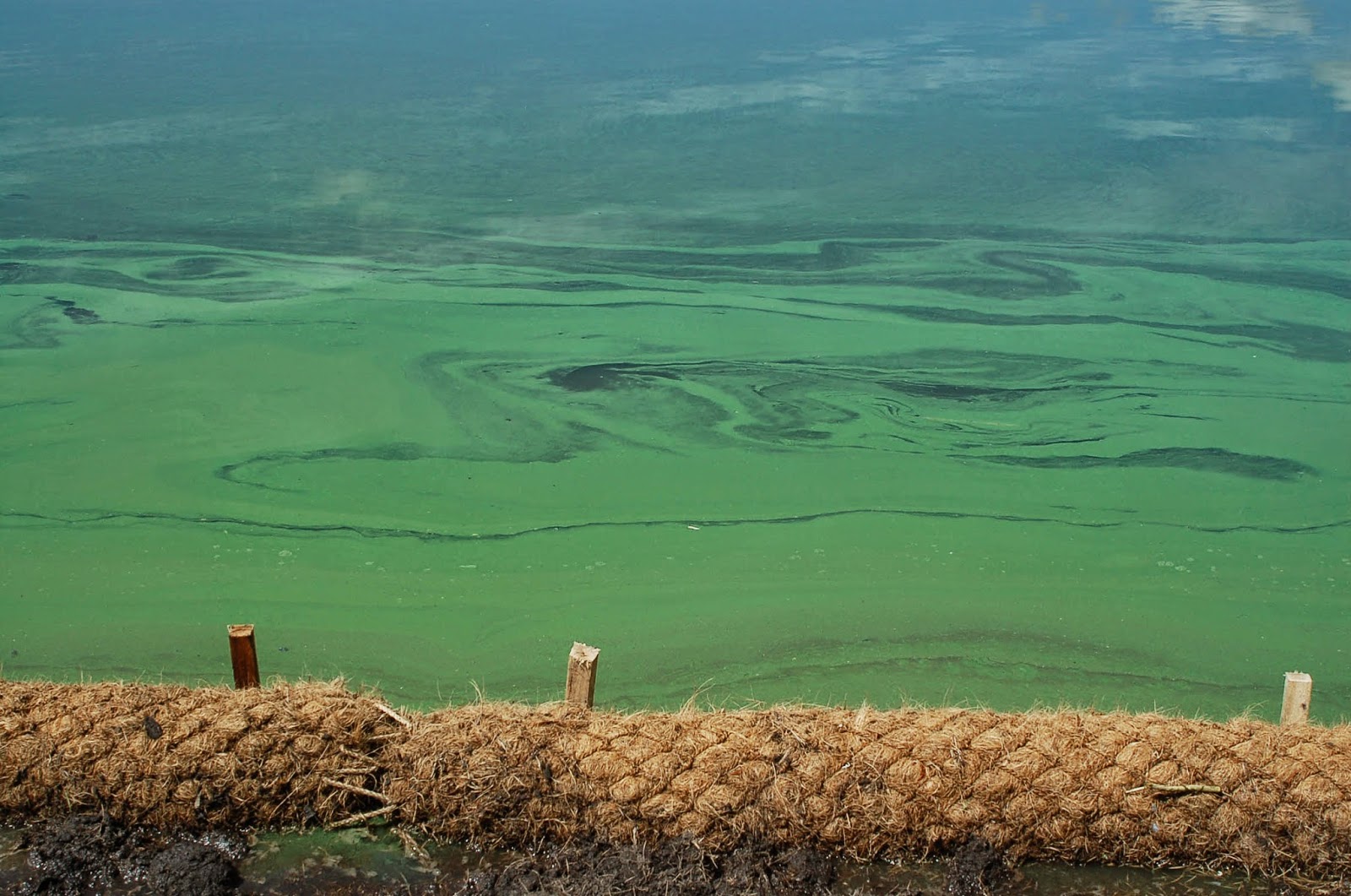

Blue green algae blooms on Casey Lake in North St. Paul were not uncommon
before a 2007/2008 shoreline restoration.  This photo taken as the restoration
began in May of 2007 and you can see the distinctive spilled green paint look.
Blue green algae is often described as looking like pea soup or spilled green paint, but it can take other forms as well. The type of blue-green algae dominant in the sample from Carver Lake -Microcystis is known to produce toxins that can be harmful to pets and humans. Not all blue-green algae blooms produce toxins; however, there is no way to predict if or when a bloom will produce toxins. For this reason it is best to avoid contact and stay out of the water. 


On July 28, the City of Woodbury took two samples at the beach for the actual toxin. Results showed trace levels that pose a low risk to humans and animals. On July 31 RWMWD water quality staff went back out to Carver Lake looking for blue green algae. They couldn’t find the typical paint like algae blooms anywhere on the lake but took an algae sample close to the beach to double check. It came back negative for the toxin producing blue green algae.

To learn more about blue green algae you can find fact sheets and photos on the Minnesota Pollution Control Agency and Minnesota Department of Health websites.
http://www.pca.state.mn.us/index.php/water/water-types-and-programs/surface-water/lakes/blue-green-algae-and-harmful-algal-blooms.html

Blue green algae blooms and mycrocystin
http://www.health.state.mn.us/divs/eh/hazardous/topics/bluegreenalgae.html


So why are there more blue green algae sightings these days? Extreme rain events - like this year's unusually wet June - washed more phosphorous into lakes. Longer, hotter summers cause algae that feeds on the phosphorous resulting in algae blooms. High temperatures coupled with rainfall washing excess nutrients into the water can combine to create harmful blue-green algae in lakes. This type of algae can harm pets, livestock, and even people.


To learn how recent weather problems are making the problem worse, you can listen to an online talk on MPR News by MPCA research scientist, Steven Heiskary who talks about how climate changes impacts the growth of blue green algae and water safety at this link:  http://www.mprnews.org/story/2014/08/07/daily-circuit-climate-cast

The Minnesota Pollution Control Agency advises if you are not certain about algae, don't take a chance.  Stay out of the water and keep your pets out too.

As Heskiary advises, “You don’t have to be an expert to recognize an algae bloom that might be harmful. If it looks bad and smells bad, don’t take a chance. We tell people, if in doubt, stay out — if you are not sure, it’s best for people and pets to stay out of the water.”

August Mystery of the Month - Robobug


It has six legs so it must be an insect…but what crazy insect is clear? And why is it clinging to a cattail? And why is it not moving?


What we captured a photo of here is not an actual insect, but what is left behind - an exuvia - when a dragonfly larva completes its transformation to adult.

If someone mentions dragonflies to you, chances are you will think of the critter with colorful wings and mad flying skills. You may have heard them called “mosquito hawks”, and envision them relentlessly & skillfully reducing the population of those little bloodsuckers. And of course those things are true –but that is not the whole story.

The majority of a dragonfly’s life is actually spent in the water, in the larval form known as naiad or “nymph”. Depending on the species, this life stage lasts somewhere between 2 months and 5 years. Like adult dragonflies, nymphs are voracious predators of mosquitos (in their larval form) but can also be large and strong enough to take down tadpoles, minnows and even small crayfish.

Once the nymph is ready to take that big step into adulthood, it will head towards shallow water and spend some time learning to breathe air. The naiad will then scale the handy stalk of an emergent plant, such as bulrush. Once it has a secure perch, the young dragonfly pushes its head out of its skin (try to imagine that!). If you look carefully at the photo, you can see the hole between the head and the small proto-wings where our model burst through.

As we are only very amateur entomologists we don’t know to which species this guy might belong (if you do know, please share in the comments below!). Whatever kind of dragonfly it is, we like to believe it survived its harrowing transformation and is out there now, doing its best to decimate the population of Minnesota’s “state bird”!

August Pop Up Quiz


In out of the way places or right before your own eyes, there are lots of things going on in our Watershed District that you can miss in a blink of the eye if you aren’t there in the moment or standing by with a camera. So just for fun, try to answer these questions about these recent “happenings.”  Answers below


1. What shrub is Jake Lindeman, Natural Resources intern, watering that just got planted in the new rain gardens installed next to the parking lot at RWMWD this month? 

 
2.  Where in the District is this?  Bonus: What subwatershed(s) and/or cities in the District drains to this structure?


3.  At which church in the District did this Girl Scout troop finish up the planting of their rain gardens this summer?


4.  Where are these Science Technology Engineering and Math (STEM) teachers from St. Paul heading off to explore with Water Quality Technicians, Dave Vlasin and Eric Korte?


5.  How many pounds of algae were harvested from Casey Lake in North St. Paul this past month? 


Answers :

1.  Black chokeberry.


The Beltline Interceptor (located at green star)
manages stormwater overflows from almost 20,000 acres
including parts of 11 cities. Click to enlarge.
2.  This is the Beltline Interceptor Pressure Relief Outlet near the DNR's headquarters near Warner Road in St. Paul. This structure serves as an energy dissipater and overflow for the Beltline Interceptor, to reduce hydraulic pressures and increase the capacity of portions of the Beltline. The Beltline Interceptor serves as an outlet for the Phalen Chain of Lakes and its tributary watershed, Beaver Lake and its tributary watershed, and the local watershed of the east side of St. Paul. The primary outlet of the Beltline discharges into the Mississippi River and this secondary outlet discharges into the channel/wetland system that leads to Pigs Eye Lake, a backwater of the Mississippi River.

3. Our Redeeming Love Church in Maplewood off of Hwy 36 and White Bear Ave.

4.  The Battle Creek water quality monitoring station near the underpass for Highway 61.

5.  56,000 pounds!


Roseville Wins Blue Star Award


Congratulations to the City of Roseville for receiving the Minnesota Blue Star Award for their efforts to protect local water quality.


The Blue Star Award program which was started in July of 2010, recognizes communities that go above and beyond regulatory requirements to keep runoff pollution from degrading their lakes, streams, rivers and wetlands. To achieve a Blue Star Award cities much complete an online assessment of their policies and practices in three core areas: 1) Water Friendly Planning and Preservation; 2) Stormwater Management Standards and Practices; and 3) Stormwater Pollution Prevention.


Lake Owasso's south half lies in Roseville.  This area of the lake is host to a diverse population of
shoreline and aquatic plants, providing excellent wildlife habitat.

Communities that score higher than 60% on their assessment earn a Blue Star Award, and those that are among the top ten highest achievers in Minnesota are listed on the Blue Star Leader Board. The award program is sponsored by a partnership between state agencies and watershed districts, along with the engineering firm Emmons and Olivier Resources and the non-profit group Friends of the Mississippi River.


The city of Roseville scored high enough on the Blue Star Award assessment to: 
 
  • be one of only 18 cities in the state to earn the rigorous Blue Star Award for excellence in stormwater management that has existed since 2010.

  • have the 5th highest score in the state and be recognized on the Blue Star Leaderboard.

  • have the 4th highest score in Planning & Preservation and 2nd highest score in Stormwater Pollution Prevention, two of the three categories that make up the award.

Sunday, August 10, 2014

Special Event: Dwindling Groundwater Reserves as Viewed through Outer Space

Save the Date!
Thursday, September 18th at 7pm at the U of MN St Paul Campus Student Center


Groundwater continues to rise as a pressing issue on local, national and international levels. Here’s an opportunity to listen to a national expert, Jay Famiglietti.


On September 18, Dr. Jay Famiglietti, who has led research exploring declines in Earth’s stores of groundwater measured over the last decade by an orbiting NASA satellite, will be delivering a free public lecture, sponsored by the Freshwater Society and the University of Minnesota College of Biological Sciences. 

Dr. Famiglietti is working on a book on climate change, emerging threats to water security and modern view of the global water crisis. His talk will be delivered at 7 p.m. Thursday, Sept. 18, in the Student Center of the University of Minnesota’s St. Paul campus. The Freshwater Society’s speaker series, now in its fifth year, honors the late Malcolm Moos, a former president of the University of Minnesota.


Register to attend: http://freshwater.org/jay-famiglietti-registration-sept-18-2014/


The satellite sensing, known as the Gravity Recovery and Climate Experiment or GRACE, detects changes in the mass of water entering or leaving a region on the Earth’s surface. And the news is not good.


“Results point to the harsh reality that groundwater in most of the world’s major aquifers — in India, the Middle East, China, and even in the High Plains and Central Valley aquifers in the United States — is being rapidly depleted, likely never to be replaced” Dr. Famiglietti says. “The global pattern of groundwater depletion also raises important concerns about the potential for heightened conflict, and about climate, water, food and economic security.”


Dr. Famiglietti is a hydrologist and professor of Earth System Sciences and Civil and Environmental Engineering at the University of California, Irvine. Learn more about the lecture and Dr. Famiglietti here: http://freshwater.org/2014/04/02/join-us-for-a-fascinating-groundwater-lecture-on-sept-18/

On the Screen: Lawn Care Video Just Released


The Lawn Care Basics video gives you water-wise & money-wise tips for your lawn.


When you look at your lawn do you just shake your head and wish you knew what you should or shouldn’t do this time of year? It’s been quite a while since I reviewed a video but I’d like to pass on the announcement that Mississippi Watershed Management Organization has recently completed a new video series - Improved Lawn Maintenance: Good Choices for Clean Water! It includes 3 segments including Lawn Care Basics, Fertilizing Your Lawn and Weed Control. Take my advice and check it out!


Here are the links:


Lawn Care Basics


Fertilizing Your Lawn


Weed Control

Tuesday, July 15, 2014

Mystery of the Month: July 2014

By Bill Bartodziej

Ample spring runoff and cool temperatures seemed to favor mat-forming algae.
The net in net-forming algae.
WARNING: Do not release your laundry drain lint traps into local waters or it could become ALIVE! Of course we're joking, but what is this net-forming aquatic stuff? One hint: it's not a plant.

Answer:  It's algae - and lots of it. 

You may have recently noticed a bumper crop of algae, a eukaryote, on District lakes - especially mat-forming algae.   


Surfaced mat-forming algae was a common sight in many of our lakes and ponds this spring and early summer. Algae samples were taken from several lake systems for species identification. We found that the mats were composed of five common species of green algae: Hydrodictyon reticulatum, Pithophora, Rhizoclonium hieroglyphicum, Lyngybya, and Spirogyra. These species are typically found in lakes around the metro area.


So why are certain years worse than others? Some watershed and lake managers speculate that all of the runoff that we had this spring-early summer has fueled these algal blooms. However, we really don’t have the data at this time to support this hypothesis.


We do know that most of us look at these mats as a recreational nuisance and a big eyesore. With some people, these mats trigger the thought of a “dirty lake” even though water quality may actually be stable and within normal levels for nutrients.


In terms of ecology, these mats are likely not causing adverse impacts to our lake systems. Some aquatic invertebrate species actually take advantage of this type of habitat. Ducks forage in the surfaced mats of algae. Small fish hang under the mats and seek shelter and food. 


To start to become an algae geek, you may want to inspect some of their finer qualities up close to start to gain appreciation. Here’s a short video,
www.youtube.com/watch?v=XeUWulMEkV8 that provides a detailed look at one of these algae - Hydrodictyon reticulatum, nicknamed “water-net.” It lives up to its name by having a net-like structure which forms membrane-like colonies.


How could something so elegant be such a nuisance?


Casey Lake now has an abundance of net-forming algae on the surface and a diverse native plant community below.  This condition is still much better, ecologically, than having no aquatic plants and frequent blue-green algal blooms (which is what we had when carp dominated the system a couple years ago).
Most Lake Wabasso residents are looking over surfaced mats of algae today, but high-quality
native plant communities are under the mats.
Some shoreland owners equate this surfaced algae to poor water quality, even though
water quality has significantly increased in this lake system.
From a recreational standpoint, large expanses of algal mats are trouble. They make boat navigation difficult and fishing is extremely challenging around these mats. From a management perspective, recreational considerations might justify control of these mats. For example, fishing access points, the boat launch, boat docks, and the swimming beach area on Lake Phalen are cleared of aquatic plants and surfaced algae.
A thriving native plant buffer on Phalen.  In the background, the surfaced algae sits on top of Eurasian watermilfoil.  Mechanical harvesting will start in early July.  The City of St. Paul and DNR pay for most of the control.
On a positive note as we reach the heart of summer, we have seen surfaced algal mats on the decline in a few lake systems. We will definitely continue to monitor these algal mats on our lakes and report any noticeable changes as we enter the dry-hot period of summer.