Showing posts sorted by relevance for query Youth Outdoors. Sort by date Show all posts

Tuesday, May 12, 2015

Youth Outdoors Gain Experience with Conservation and Natural Resources

By Simba Blood

Youth Outdoors teens taking a break at Keller Channel

For the past two years, RWMWD has served as a project host for the Conservation Corps Minnesota’s Youth Outdoors program. Youth Outdoors offers low income urban teens (ages 15-18) an opportunity to gain experience with conservation and natural resource management projects while also learning important basic “first-job” skills.

Cleaning up leaves at Keller Lake

These young folks are organized into
crews of six youth and two Conservation Corps Minnesota crew leaders, each

working out of a different recreation center. This spring we are hosting work crews for eight out of the ten weeks of the program.

The St. Paul crews we have worked with are an ethnically-diverse group of students from Johnson and Harding High Schools, including those who identify as belonging to Hmong, Somali, Central American, African American, as well as other communities. 


Constructing brush bundles


Brush Bundles


With these young folks we have transplanted seedlings, removed trash from pond shores and stream corridors, planted sedges and flowers in restored sites, weeded invasive plants including garlic mustard and burdock, collected native flower seeds and even constructed brush bundles for use in the upcoming Keller Creek restoration.

Youth Outdoors team picking up trash

As with any teen, enthusiasm for the work varies from job-to-job, day-to-day or even minute-to-minute! Overall the groups are upbeat, engaged and enjoyable to work with. This program appears to be an excellent venue in which to connect with students who have previously not been involved in Minnesota parks and natural resources management work.

To learn more about this program, visit the Conservation Corps Minnesota webpage.


Monday, June 27, 2016

Stories of an Oasis - Tales in Southwood Nature Preserve

By Sage Passi

Maplewood Nature Center Naturalist Oakley Biesanz prepares seventh graders for invasive plant removal in the Preserve in 2015.

It’s been ten years since Southwood Nature Preserve in North St. Paul was “born”. The wood chipped trails in the park lead you around the pond and through the ecosystems of emergent shoreline, wet meadow, mesic prairie, savanna, upland prairie, oak forest, basswood forest and a cottonwood/silver maple flood plain. The Preserve is gradually being transformed. Volunteers are currently working to restore the oak savanna habitat that once included oak trees, native grasses and wildflowers.

Welcome to Southwood’s pre-teen years. Parenting is never easy. But it’s easier if you have a village. 


Birth of a Park
by Dave Nelson, North St. Paul Master Naturalist


Buckthorn removal at Southwood Nature Preserve


It was 2006. I went to a city meeting that was open to the public. I told them, “You have a gem of an open space – a diamond in the raw. It just needs tender care”.

We talked about all the buckthorn and honeysuckle. It’s got to come out. You couldn’t see through it. You couldn’t see fifteen feet. I told them that we were going to have a buckthorn cutting day the first weekend in January.

So we waited down here. Nobody showed. So Donna and I started cutting and treating the invasive buckthorn and honeysuckle. We cut for seven and a half hours. On Sunday we started hauling it out and dumping it in the oak savanna.

Some of the neighbors didn’t like what we were doing so they called the police. When the police came I was unloading the trailer loaded with buckthorn. When Donna saw the police she ran for the woods!

So the officer said to me, “What in the world are you doing?” I told him what had happened at the city meeting.

“There were supposed to be a group of people here…but nobody came.”

I asked the officer, “Did you come to help?” He didn’t think that was too funny.

We kept on hauling buckthorn out and in the spring we started on the Japanese knotweed. The first year we filled seven trucks full. They hold 500 yards or more each. The buckthorn and honeysuckle are now 70% gone.  


Lunch for volunteers at the park.


Spring Growth Spurt - The Village Invests in a Prairie
by Sage Passi


St. Peter fourth graders plant seedlings in a prairie area of Southwood Preserve in mid-May.

I’ve concluded you have to be eccentric to take on projects of this magnitude. I’m not exaggerating when I say this is a production with a cast of thousands. Visualize all the human and non-human “ecosystems” behind the scenes intersecting and humming like bees in a bergamot field. 


Mitch Thomsen's science lab turns into a nursery for prairie plants. Ramsey County Master Gardener, Kris Baird, helps Mounds Park Academy students transplant seedlings.


Wikipedia defines an ecosystem as a community of living organisms in conjunction with the nonliving components of their environment There’s no way to get to the bottom of this macro/micro-cosmic To-Do List. The fungi rotting the wood, the microbes breaking down the nutrients, plants absorbing nutrients from the soil, Praire Moon staff and interns gathering and cleaning seed, Master Gardeners helping kids plant the seeds in trays, transplanting those little seedlings, schlepping trays hither and non, endless watering, the electricity powering the grow lights, weed seeds doing their thing, dozens of volunteers and Master Gardeners and Master Naturalist stepping in to help. It’s a complex of relationships and interactions all linked together.


Master Gardeners and a youngster bring new life to the prairie.
Barbara LeTourneau watches as a St. Peter fourth grader waters his newly-planted prairie plants.


I’m just giving you the short list. Preparation for a field day begins months and months before. Years really. I won’t try to take this from the top. Let’s just start with last fall.


Master Naturalist Cathy Troendle introduces me to a prairie she is restoring in
Southwood Nature Preserve in early April.


Cathy Troendle, a North St. Paul Master Naturalist,is the master mind and organizer for an annual spring field day with a round robin of activities for Maplewood Middle School seventh graders in Southwood Nature Preserve, two blocks from the school. She has orchestrated this event for two years. This spring we estimated that 233 students would be participating. The field day typically includes buckthorn busting, bird watching, wetland monitoring and bird migration.

This year I decided that I wanted a hands-on activity that would prepare these seventh grade students for their upcoming rain garden project at their school next fall when we would plant three large rain gardens to capture run-off from their parking lot and driveway.

Both Cathy and Deb Armstrong, each North St. Paul Master Naturalists, have “adopted” sections of upland prairie in Southwood Nature Preserve and seeded them last fall. It’s an on-going challenge to establish a prairie in an area that has a large seed bank of “weeds”. 


Deb Armstrong, like Cathy, has been working to restore prairie and woodland sections
in Southwood Nature Preserve for many years.

“We could grow additional plants to add to the diversity,” I suggested as my imagination widened like the aperture on my camera lens. 

“St. Peter School could plant the woodland trail,” I thought. It would be a chance to introduce them to some shade-loving woodland species like columbine and Jacob’s ladder that aren’t in their own prairie garden at their school. I was blissfully imaging a woods full of spring ephemerals.


Rue anemones have appeared in the woodland
since the buckthorn was cleared
.

“And the seventh graders could plant the prairie,” I added. Little did I know what I was getting into when I dreamed up that mammoth proposal. You could tell I was in the early season bliss of a new school year.

I did the math. Four plants per person times 233 = 932 plants for Maplewood Middle School. That’s close to 20 flats we needed to grow.

“Should be feasible,” I said confidently to myself. 


We often grow more than 100 flats each year. Growing them is one thing. Planting them outside in less than ideal conditions is another, but keeping them watered is a whole different ball game in a couple prairie fields with only a fire hydrant several hundred yards away and a rather dry spring. 

“That’s how many hoses?” I would ask myself later.

I put that out of my mind for a few months and set to work.

I should say a lot of people set to work. You could tell I wasn’t really looking ahead very closely to some of the challenges we would find along the way. Something akin to new love had set in.


The Nursery Phase
 
My eyes fixed on the recently gathered columbine seeds in the multi-purpose room. My appetite grew bigger and I ordered three columbine packets from Prairie Moon, plus some other seeds that hadn’t been gathered, so that we could stratify them in December.


Columbine seeds gathered by Natural Resources
interns at the Watershed District

Students in classes at eight schools started on the journey to mass production of seedlings. This process has three steps – stratification, seed planting and transplanting. Ramsey County Master Gardeners flocked to sign up for shifts at the eight schools. These are popular volunteer activities for Master Gardeners because they happen early in the year before they get too busy outside in the late spring. 

Rochelle Robideau, Ramsey County Master Gardener School Coordinator,
runs the school "greenhouses" each year.


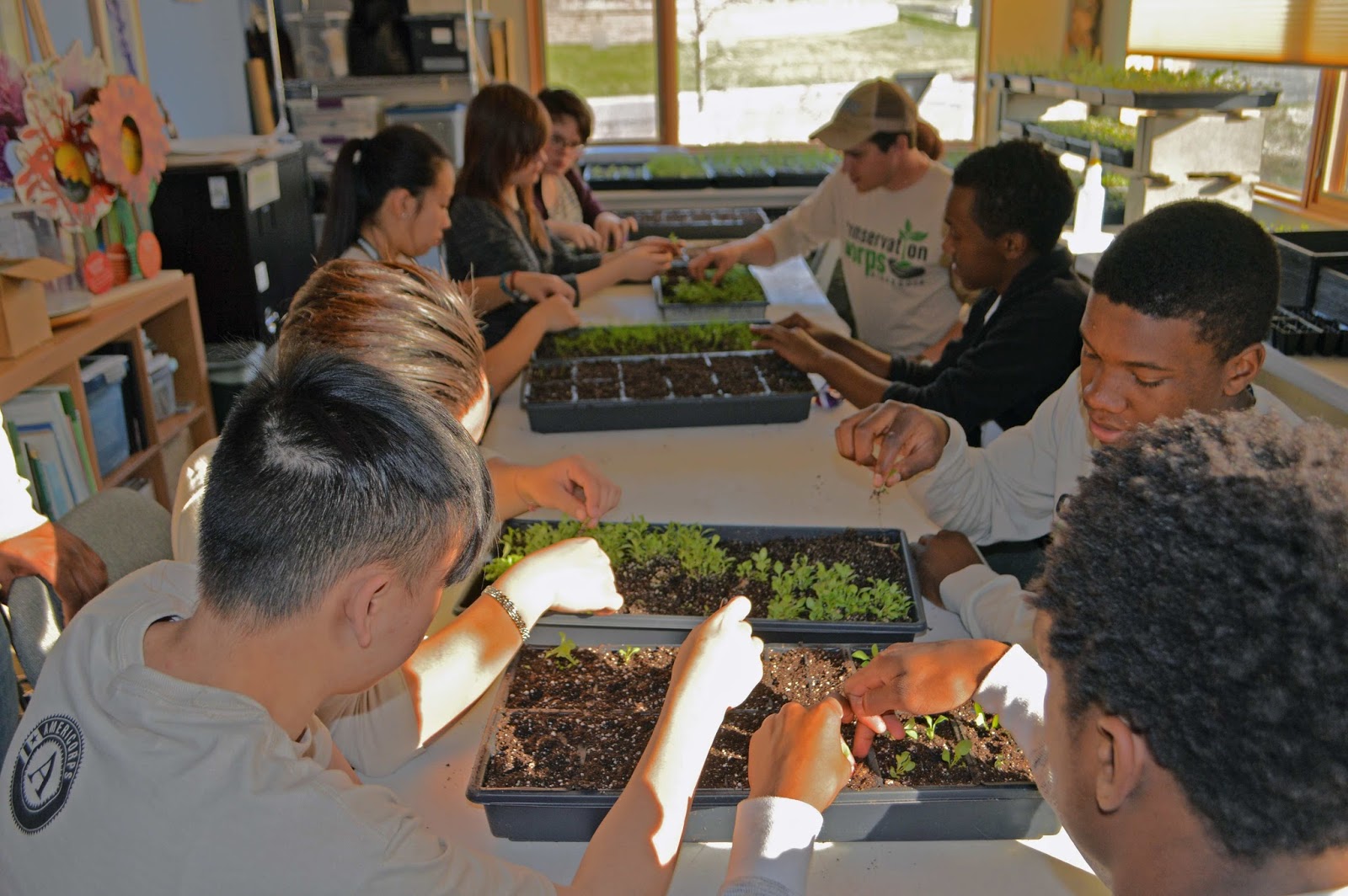
Each year the number of trays keeps multiplying. In addition to the light racks at all the schools, they fill our District office multipurpose room and a light rack in my living room. One afternoon Simba Blood, our Natural Resources technician asked if her late afternoon Youth Outdoors team could help transplant seedlings. The asters were on steroids – so I welcomed the assistance. I didn’t realize they were going to transplant all of them! The next day I came back and every inch of surface area was covered with trays of aromatic aster, sky blue aster, spiderwort and showy penstemon. Yikes!


Youth Outdoors, a high school job training group, works with our District twice a week in the fall and spring. They helped transplant some of the seedlings.


St. Paul Academy seventh graders capture the seedling frenzy on camera during a field trip to our office.


We began preparing for the field day. My head was soon filled with the logistics of orchestrating 233 students in twenty minute planting shifts. Cathy began the task of laying out the planting plots which took many, many hours. Patches of green were appearing in our planting areas. WEED ALERT!!! By the time we got to plant in mid May these “unwanteds” were starting to fill up our transects.

Cathy and I visited the eight Maplewood Middle School classes and St. Peter’s classroom to orient the students before the planting. Excitement was growing at the school. 


Maplewood Middle School seventh graders discover how long prairie plant roots can be - sometimes up to 15 feet long!


Cathy Troendle helps St. Peter students practice
how to measure soil temperature and humidity
for their field day in the prairie and the woodland.


Spiderwort is thriving!

As the planting day approached I decided to transport nineteen flats of plants home to my house in several car loads so I could get them all mixed up and ready to go a couple days before the planting date and deliver them directly to the site on the day of the planting.


Field Day Here We Come


YouthBuild tackles the prairie section near the pond after a heavy rain delay.


On the day before the planting we followed the forecast online hour by hour. It became sadly obvious that we were going to get rained out. But the wheels had already started turning. This was a machine in motion and we couldn’t turn back, but we were going to have to cancel the field day on Tuesday. It was too complicated to reschedule the 37 adult volunteers, or the eight classrooms and the logistics were too complex to recreate this event on another day with the Middle School.

We spent the next two days getting reorganized. There were almost a thousand plants waiting to get into the ground. We already had St. Peter Catholic School fourth graders lined up to come to plant on a different day so we decided to scrap the woodland planting with them and concentrate on getting those prairie plants in the ground. Cathy got on the computer and recruited new adult volunteers. A contingent of Master Naturalists was e-mailed. Some of the Master Gardeners were available for the next attempt.


Through Cathy’s contacts she finally landed on a goldmine. A group called YouthBuild, ages 18-24 emerged to help us. The connection came through North St. Paul’s Park Board member, Sarah Joe Zahradka. In 2015 this group had helped build the fishing pier at Casey Lake in North St. Paul. 

Her husband, Tony, offered the services of students at a school he works at on the west side of St. Paul, Guadalupe Alternative Programs (GAP). GAP, a contracted site of St. Paul schools, serves immigrants and disadvantaged youth and their families in transition. GAP is a member of YouthBuild Americorps, an international organization that combines education with community service. Learn more at:   https://www.youthbuild.org/about-youthbuild-usa.

On the day of the planting, the YouthBuild contingent pulled up in several vans, picked out their trowels and gloves and set to work. We were awed by their diligence and dedication to the job!


YouthBuild to the rescue!

The YouthBuild volunteers were fast and skilled planters and within an hour and a half a large part of the prairie was planted. 


A YouthBuild volunteer prepares to plant a seedling in his plot.
Ramsey County Master Gardners Linda Neilson, Barbara
LeTourneau and Joe Baltrukonis assist others in another plot (rear).


While YouthBuild was planting, Cathy led St. Peter’s students in a field investigation to compare prairie and woodland habitats.


St. Peter fourth graders compare two plant communities and record their air and soil temperature, moisture, light conditions and pH.
Photo credit: Tracy Leavenworth

In the meantime, Dave Nelson kept busy hauling rain barrels that he transported on his wagon from the hydrant across the street. The adults filled the pails with water and set them in the aisles and the brigade of youth volunteers began watering and refilling their pails from the rain barrels.


Dave Nelson performs the role of providing water for the seedlings in rain barrels filled at the fire hydrant across the street.


St. Peter students arrived on the scene for their planting shift and the Youth Build volunteers went off with Cathy to pull garlic mustard in another section of the preserve.


Joe Baltrukonis, a Ramsey County Master Gardener, assists St. Peter's students in the planting.

We all went home that night tired and thankful that we had pulled off our planting despite all the hurdles that we had to jump to get it done. 


St. Peter celebrates the completion of their Southwood prairie planting day.

A week later we came back with two crews from Youth Outdoors and finished planting all the aisles between the quadrants and watered both gardens. 


Youth Outdoors assist RWMWD with the prairie restoration.

RWMWD partners in the spring and fall with Conservation Corps Minnesota’s Youth Outdoors program. Youth Outdoors offers low income urban teens (ages 15-18) an opportunity to gain experience with conservation and natural resource management projects while also learning important basic “first-job” skills. To learn more, visit: Youth Outdoors Gain Experience with Conservation and Natural Resources.


Youth Outdoors finished off this year's prairie planting at Southwood Nature Preserve.


The prairie had been rejuvenated and our village cheered when about a week later the rains finally came!

Photo credit: Tracy Leavenworth

Photos in this article were provided by Sage Passi, except where noted.

Wednesday, December 16, 2015

Honoring Citizens' Excellence in the Watershed

RWMWD’s Watershed Excellence Awards Program honors individuals, organizations, government entities and businesses that demonstrate outstanding achievements in water resources management, watershed stewardship and civic engagement within Ramsey-Washington Metro Watershed District. 

Each year it's always a difficult decision determining who should be given these honors because there are so many deserving individuals and groups in our Watershed. It is exciting and heartening to know there are so many people who qualify for this distinction.


So we will continue to honor and express our thanks to many of you each year!


How does the Watershed Excellence Program work?

A District Citizen Advisory Commission committee teams up with Watershed Education Specialist Sage Passi through the summer and fall each year to solicit, submit, review award nominations and recommend the winners to the Board. Then, they conduct interviews to round out the story about the award winners. 

In addition, they identify, recruit and engage artists who submit proposals for the design of the “artistic” award itself. The CAC committee also recommends the final selection of the award design to the District’s Board of Managers.

Here are stories of some of our 2015 Watershed Excellence Award winners. Be watching for the stories about the other winners in our next Ripple Effect. 

- - - - - - - - - - - - - - - - - - - -


 Jill Danner – 2015 Watershed Excellence Award for Youth Engagement


Photo credit: Anita Jader


A round of cheers for Jill Danner! This award recognizes a teacher or youth organizer who has demonstrated exceptional commitment and capacity to engage youth in watershed education and stewardship initiatives.


Harding Earth Club gets directions from Jill about planting acorns.

Jill is a real powerhouse and a creative organizer who has involved youth from the East Side of St. Paul in many environmental actions over the years. Young people gravitate to Jill because she makes things fun! 


Jill talking with students about tending oak seedlings.

Jill, a former TA at Harding High School, started and ran the Harding Earth Club for eight years. As many as eighty kids attended the club that met each week during her tenure.

Jill is still in touch with many of her volunteers through Facebook even though she retired a couple years ago. Former club members write to her about their trips out into nature and keep in touch because Jill made a real impact on them. She made a point of getting youth outdoors on projects in order to instill a love for the environment and to teach them how to protect it. She took the Earth Club on camping trips, visits to her horse stable and bus trips around the watershed to work on projects, all in the spirit of group fun and empowerment.


Jill and the Harding Earth Club use GPS to document
plants in Parkway Woods.

You name it ... Jill has done it with kids and with gusto.
 

Jill passed the reins on to other teachers when she retired several years ago. Teachers, Shannen Lachkameya, Sinthaug Has and Andy Jones continue to support the Earth Club. Jill’s influence has taken root with twenty-five to forty kids who meet weekly to learn about environmental issues and work on projects together.

Preparing for a District hill restoration

The Earth Club’s focus has always been on action. Jill's accomplishments with youth over the years include a Phalen Chain of Lakes clean-up involving six bus loads of student volunteers, numerous restoration and invasive species removal projects around the cities, education outreach activities about environmental friendly cleaning projects, volunteering at WaterFest and annual plant sales at Harding High.


The Harding Native Plant Labyrinth

Two of Jill's legacies leave visible reminders of her positive watershed influence - a native plant labyrinth in the high school courtyard that students helped design and build and a massive planting of native plants behind the Watershed District office on a steep hillside slope that helps reduce erosion into Gervais Creek.

Harding Earth Club working to stop erosion
on hillside behind District

Jill continues to be involved with the Watershed District today. She serves on the Citizen Advisory Commission and provides counsel on community endeavors like the Phalen Chain of Lakes Water Trail Project and Phalen Freeze Fest.

Congratulations, Jill! Thank you for your vision, enthusiasm, mentoring and spirit of adventure.


- - - - - - - - - - - - - - - - - - - -

Wonder who's behind the beautiful plants you see in the District’s restoration projects, shorelines, rain gardens, our office site and other projects around the District?

Celebrating the accomplishments of Sean Uslabar

It’s Sean Uslabar: 2015 Watershed Excellence Outstanding Partner 

The District honored Sean Uslabar with the 2015 Watershed Excellence “Outstanding Partner” Award. This award recognizes an individual, group or business that effectively collaborates to achieve exceptional results in water resources management in Ramsey-Washington Metro Watershed District.


Award Winner Sean Uslabar
with Tina Carstens and Bill Bartodziej

Sean, Manager of Ramsey County Correctional Greenhouse and Nursery Facility, is the man behind the scenes whose green thumb, business sense and skillful knowledge about growing native plants, shrubs and trees has supported the District’s large and small scale habitat restoration and stormwater management efforts for many years.


Sean partners each to grow thousands of native
plants, shrubs and trees for our projects and
others around the county and state.

Sixteen years ago, Sean started the native plant operation at Ramsey County Corrections and the production has been growing ever since. Over the years, he's provided hundreds of thousands of native plants for the District’s projects.

His work has improved the quality of our restorations and saved the Watershed tens of thousands of dollars in the process. In addition, he provides native plants to cities, counties, nature centers and many other organizations throughout the state.


Sean wearing one of his many hats
at Ramsey County Corrections

Sean does it all; he balances the budget, fills orders, manages inmate crews, runs the greenhouses and even finds time to share his knowledge by giving tours.

 
Sean fills an order for HB Fuller’s restoration project.

Sean supplies trucks, tractors, and inmate work crews for District projects and has even been known to get out into the field as well, seeding natural areas on Keller Golf Course.


Sean seeds a Keller Golf Course restoration area.

We express our deep appreciation Sean, for being such an outstanding partner!

- - - - - - - - - - - - - - - - - - - -

Maxine Bethke – Conservation Champion


Maxine Bethke - Conservation Champion

Congratulations to Maxine Bethke, an Oakdale resident, who was awarded the  "Conservation Champion" Watershed Excellence Award!

This award recognizes an individual or organization that works tirelessly to improve and protect the natural environment, persevering enthusiastically through the most trying of conditions.


Maxine Bethke received the “Conservation Champion”
 Award for her conservation efforts in Bethke Park in Oakdale.

Maxine started a neighborhood sanctuary and has been a long-time advocate for Bethke Park, a seven-acre nature park in Oakdale. Previously dominated by buckthorn, reed canary grass and hybrid cattails, it is now a vibrant place with native plants and wildlife galore, thanks to Maxine's efforts and others she involved including agencies, organizations and individuals.


Bethke Park in Oakdale

Click here for a map to Bethke Park.

Maxine removed mountains of buckthorn, planted a forest of native trees and shrubs, controlled a slew of invasive weeds, planted a host of native flowers and documented the re-emergence of many native woodland plants, including some rare and threatened species.


Maxine turned an invasive-dominated piece of
land into a jewel of a park for everyone to enjoy.

She turned the park into a nature observatory; installing and maintain wood chipped trails, bird blinds, benches and boardwalks. She has also installed a Little Free Library stocked with identification guides and other nature-themed works.

Thank you, Maxine for your long-standing commitment to conservation and habitat improvement!
- - - - - - - - - - - - - - - - - - - -

We greatly appreciate all our 2015 award winners. Watch next month for more inspiring stories like the ones you've just enjoyed.