Monday, January 13, 2014

Mystery of the Month - January


If you had to tell a story or explain your job in only six words, what might those words be? 
I put this task out to the District staff and got some fun responses. 

For this month's mystery of the month, we start with just one.
See if you can guess what this person does, or even who this person is:

"Plants, mud, big boots, power tools."
Think you know?  Want to see how the rest of the staff explained their day to day? 

********************


The answer to this month's Mystery of the Month is from our staff member who contributes most often to our past Mystery of the Month articles. Thumbs up if you guessed Simba Blood, Natural Resources Technician.

As for the rest of the staff, here are their six-word stories.
Cliff with Maplewood Mall

collaborating partners.


"Staff, budget, Board, collaboration, committees, meetings"
-Cliff, Administrator


"Payroll. Accounts-payable. Spreadsheets. 10-key. Numbers.     Gray-hair."
-Sue, Accounting Assistant


Sage Passi, touring the green 

roof at the Target Center.

"Communications, creativity, teamwork, resources, teaching, connections"
-Sage,  Watershed Education Specialist


"Rules and regulations. Compliance and enforcement."
and  "BMPs approved. Free money to improve."
-Paige, Watershed Project Manager, describing both of the (hard)hats she wears as Coordinator of the Permit and Best Management Practice Incentive (Cost Share) Program


Nicole ensures erosion control
fabric is properly installed.

"Prevent Erosion, Control Sediment, Protect Waters."
-Nicole, District Inspector


"Fun, Interesting, Different, People, Helping, Challenging."
-Dave, Water Quality Technician


"Connecting the dots. Planning for future."
 -Tina, Assistant Administrator


Eric demonstrating (in a t-shirt) 
how boiling water vaporizes

in -20 degree Fahrenheit air.
"Rain. Water Level Up. Samples. Repeat."

- Eric, Water Quality Monitoring

Coordinator


"Water, Ecology, Restoration, Enjoyment, Life, People"

- Bill, Natural Resources Specialist


"Invasives, partner, educate, volunteers, communications, eradication!"
Paige pointing out something good, 
I would imagine.
-Carole G., Ramsey County Cooperative Weed Management   Area Coordinator (Notice: her title is longer than six words!)


"Points, polygons, pictures, rowing, collecting data"
-Carrie, GIS Technician


Carrie and Bill collect ice and water
measurements on Markham Pond.
"INFORMATION: anticipate, gather, scatter, storage, repeat"
-Carole P., Administrative Secretary


"Citizens, conversations, phones, maintenance, clerical, help"
- Shelly, Secretary/Receptionist


Dave doing volunteer research of aquatic 
species in other Minnesota lakes.
Carole Gernes fishing in the 
Gervais Mill Ponds.


Thanks, gang, for playing along.

Gather at the Community Confluence: Where Conversations Meet


We invite you to a public event, Community Confluence: Where Conversations Meet to be held on Thursday, January 30 from 6:30 PM to 8:00 at Maplewood Community Center (Room C and D) at 2100 White Bear Avenue in Maplewood. This gathering is being planned by Ramsey Washington Metro Watershed District for citizens, organizations and city and agency representatives.

A word cloud illustrating what community members said they value most.


We’ve collected your concerns and solutions related to lakes, rivers and wetlands in Ramsey-Washington Metro Watershed District at our Community Conversations meetings held this fall in Maplewood, Shoreview and Woodbury and through e-mails, letters, phone calls and social media. Staff and our consultants spent many hours compiling your comments and input. Now it’s time to prioritize those issues and suggested actions to guide us in preparing our ten year watershed district management plan. The input you provide will be presented to the Board of Managers and Watershed Staff to help them develop the plan over the next year and a half. The following issues/actions represent what we heard from you. They fall into eight main categories. These include:

  • Educate and Involve Citizens
  • Manage the Organization Effectively
  • Promote Quality Surface Water
  • Achieve Healthy Ecosystems
  • Provide for Flood Control
  • Sustain Quality Groundwater
  • Promote Innovative Development and Redevelopment
  • Support Recreational Access to Water Resources

Come and listen to a summary of the input we’ve received and join in the prioritizing process using an activity called DotMocracy. We welcome and value your input and encourage you to attend. Please invite anyone else you think would be interested in participating. Refreshments will be served.


Please RSVP at http://tinyurl.com/community-confluence or just come!

Here is a link to a summary of the input we've collected to date:  

We hope you can make it on January 30th!  We look forward to seeing you.
For more information please contact Sage Passi, Watershed Education Specialist
at sage.passi@rwmwd.org or 651-792-7958


Sunday, January 12, 2014

Slippery Slope of Salt


Snow and ice removal can seem like a big job!


I have a confession to make. I don’t salt my sidewalks in the winter. We live on a corner lot with a well-used sidewalk and an elementary school nearby, yet I never grab the salt bag when the ice gets really bad…I let my husband do it.


I am a hearty and committed shoveler and will do so several times in a snowfall if I can, but in the rare instances when we need it, I don’t touch the salt bag. Perhaps it’s because that frees up my conscience because I know that just a teaspoon of salt can permanently pollute five gallons of water.  I also know that when the snow and ice on my sidewalks melt (which it will someday), the salty water runoff will enter the storm drain on my block and head right to the Mississippi River untreated. If I’m not holding the bag, I’m not contributing to the problem right? 
 
Clearly, and humbly, I know my logic is flawed. 


In both the watershed in which I live and in the watershed in which I work, there are multiple water bodies impaired for chlorides. Perhaps you’ve heard this in the paper, on the radio, or the evening news. What does this mean and whose problem is it? Because there is currently no good way to remove the chloride, what can we do? There are some answers to these questions, and still more to learn.


What does it mean?


Salt or chloride impairment means that a water body (lake or creek) has received too much salt from untreated rain water or snow melt running off of salty surfaces. This usually includes roads and sidewalks treated with sodium chloride, calcium chloride, magnesium chloride or another melting agent to remove ice. Water and snow melt that enters a stormdrain is not filtered before emptying into our lakes.
 

In these ‘impaired waters,’ the salt levels are high enough to negatively affect fish, aquatic plant life, and other wildlife that depends on a healthy lake system. Just as we can’t put a sunfish in a saltwater aquarium and expect it to survive, we can’t let our lakes become saltwater systems and expect our freshwater wildlife to survive.  
 
Chloride pollution is a big and preventable problem.


Whose problem is it?
  
In short, it is my problem. Now read that last sentence out loud.
  
Everyone, regardless of the size of your house, the proximity to a visible water body, and even regardless of your salt use (or lack thereof) can play a role. Every last bit adds up quickly and the more you and your neighbor know, the better.

While it may be easy to point fingers at retailers and city road crews, know that many of them are already working to reduce their salt use. The Minnesota Pollution Control Agency (MPCA) has helped bring this issue to the forefront and cities and retailers are starting to step up. The MPCA even offers a certification for snow and ice removal contractors who have had formal training on how and when to use chloride products effectively while reducing their impact on the water (and saving tons of money at the same time).
What can we do?

If this is the first time you’re reading about this issue, thank you for getting this far. You’re now in the running towards becoming the next top model (citizen). Here are a few easy things you can do with the most recent snowfall:
  1. Shovel often, shovel early. Removing the snow from walking surfaces before the snow gets compacted means you may not even need to add deicers.
  2. Know your salt. If the air temperature drops below 15 degrees, most deicers don’t work. Read the label; know what’s in the bag and when you’re wasting your time and (natural) resources.
  3. As an alternative to salt or if it’s too cold for typical deicers to work, consider traction grit.
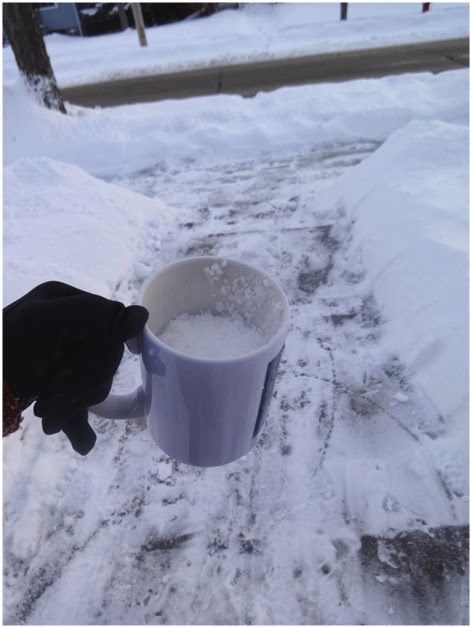
  4. Do not give your sidewalks high blood pressure by over salting their diet. More salt does not mean more melting. The MPCA recommends using less than 4 pounds of salt per 1,000 square feet. Think of it this way: one heaping 12-ounce coffee mug is about one pound. That should be enough for 1.5 to 2 parking spaces. Salt crystals should be separate from each other and not be piled up. Use a hand-held spreader in wide areas for consistency.
  5. If the temps are right and an ice or sleet storm is imminent in the forecast, put a little salt down first. This will help break up the ice from the bottom up which is far more effective.
  6. Sweep it up. Whether you used sand or salt to get through the most recent storm, when the pavement is dry, get a broom and dustpan out. You can either reuse the salt in an icy area or save it in a 5-gallon bucket for the next storm.
  7. If you hire a contractor for your home or office snow and ice removal, consider looking at the MPCA’s certified contractors list or ask your current contractor to get certified. Not only will this help your own site minimize its impact, it will send the message to contractors that this is an important issue to their customers.

These easy actions are just the tip of the iceberg. If you want to know more about chloride pollution, which lakes are impaired, how to get certified, or what more you can do, visit the
MPCA’s webpage about road salt and water quality. It is a very user-friendly resource for details on all of these things and much more. Use their interactive map of impaired waters in the ‘TCMA Chloride Project’ tab halfway down the page to see what the waters look like in your city.  Another great source for more information is this Youtube video: Improved Winter Maintenance: Good Choices for Clean Water 

Little H. says "Use a broom for light dustings of
snow, or to sweep up unused salt and sand." 


Clearly knowing the problem of salt pollution isn’t enough. Action is needed. Knowledge is power (according to GI Joe) and with power comes increased responsibility (according to Spider Man). Using the advice of these animated heroes, I’m ready to take over the reins….or the salt bag, as it were, and be a better Minnesotan who can balance being a clean water hero and courteous neighbor to the best of my ability.


Incentive and Inspiration to Help You Improve Water Quality


Wells Fargo in Maplewood used cost share money for their parking lot reconstruction where
they installed two infiltration basins and eight parking lot island rain gardens.


RWMWD is now accepting applications for the 2014 cost share program! 

The program offers technical assistance and cost share funds to support projects that improve water quality. Funds are available to residential homeowners and large property owners including schools, churches, townhome associations, commercial businesses, and government entities. Below are the coverage allowances and criteria for the cost share program. Additional information, including a map of priority areas and application materials, can be found on our Best Management Practices (BMPs) Incentive Program webpage.

2014 Coverage Criteria

Type of Property Type of Projects Cost Share % Maximum $ Approval by Application Deadline
Residential Homeowner designed rain gardens 100% $500 Staff Rolling Year Round
 Residential Habitat restoration, rain gardens without roof or street drainage* 50% $2,500 Staff Rolling Year Round
Residential Rain gardens with street or roof drainage, pervious pavement, shoreline restoration, green roof* 75% $2,500 Staff Rolling Year Round
Habitat Restoration 50% $7,500 Board if over $5,000, otherwise staff Rolling Year Round
Commercial Church     School        Government Shoreland Restoration 100% below 100 yr flood elev. with actively eroding banks $100,000 Board Board Meeting Deadlines
Water Quality BMPs $50,000 Board if over $5,000, otherwise staff Board Meeting Deadlines
75% in non-priority drainage areas
100% in priority drainage areas $100,000


Here are a few other examples of recent projects that used District cost share funding. We can't wait to see what these look like when the plants mature!


Round Lake Townhome Shoreline Restoration
Residential rain garden in St. Paul


Residential rain garden in Shoreview.
Residential rain garden in North St. Paul


What will your project look like?


Friday, January 10, 2014

A Raingarden – Poetic Justice for Our Waters

By Sage Passi
Farnsworth students get their hands dirty.

“Last night the rain spoke to me slowly, saying, what joy to come falling out of the brisk cloud, to be happy again in a new way on the earth!”
   -Mary Oliver

There’s a change that comes over you when you put a raingarden in your yard. People who build a raingarden develop a special appreciation for the rain. I’ve heard many testimonies about that. Stories like people going outside in their pajamas to watch the water flowing through their dry creek beds into their raingarden or watching for hours as the water flows down their rain chain into the soil and flowers below. Maybe it has something to do with the opportunity it opens up to closely observe that primordial interrelationship between earth and water. Go ahead. Absorb yourself in this rewarding pastime. When you immerse yourself in the joys of being a water watcher, you will also be assisting the rain in finding its way naturally back through the groundwater, returning it clean to rivers and lakes that lie beyond.

Cultivars and native plants in Trinity Presbyterian Church's raingarden 
bloom (left) and get a soaking (right) in Woodbury.
When you build a raingarden, you prevent rain from traveling down the treacherous paths of driveways, sidewalks, parking lots and streets where it can pick up trouble along the way. Keep those hitch hikers - leaves, grass clippings, phosphorous, sand, salt and automobile accoutrements (oil, gasoline, windshield washer fluid and anti-freeze) from tormenting your local lakes, wetlands and streams downstream. Let the run-off and its riders from those impervious surfaces get channeled into the nearby soil instead. Prevent flooding and reduce the volume of run-off that has to be treated in stormwater ponds or our local wetlands. Then stand back and watch, guilt free! And if you can’t build a raingarden for whatever reason, try planting trees and native gardens in your yard to capture and soak in the rain!


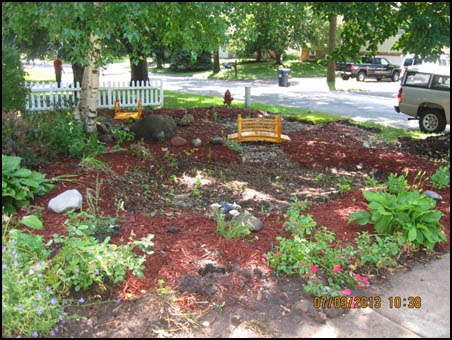
Gene Whipple, a Battle Creek resident got his inspiration for doing a raingarden in his own yard from a raingarden planted at his school -Crosswinds Arts and Sciences. In the second year he added more plants to his raingarden to keep pollutants from running off his and his neighbor’s adjoining driveway into the nearby creek.
 

“That’s what it said, as it dropped, smelling of iron, and vanished like a dream of the ocean into the branches and the grass below.”  

-Mary Oliver


Gene Whiple's raingarden - summer2013.

So how can you learn about and practice the art of building raingardens? Each year the Watershed District teams up with our faithful partners to offer a series of classes and hand-on experiences to help walk you through the process of designing and installing raingardens. Hear from experts and get assistance in assessing your yard and planning your project.


Stopping Water Where it Drops participants watch as a pit is
dug to measure the soil's infiltration rate where a rain garden
will be constructed.


This year we’ve extended our classes to encompass the communities of Maplewood, Roseville, Shoreview, Woodbury and Oakdale. Classes start in March. See the schedule below.
 
We offer cost share programs to help you design your project and cover your expenses including hiring someone else to help you build your raingarden if that seems easier. In 2014 we’ve added something new to our BMP Cost Share program. We will now be covering the cost of curb cuts if you would like to capture and infiltrate street run-off into your raingarden. Click here to link to more details about our cost share program.


So sign up and tell your friends about our Stopping Water Where It Drops series or the Blue Thumb all in one rain garden classes. If you have already taken any of these classes and want to spruce up or amend some problems in your raingarden, sign up for the Raingarden Rescue or Divide and Conquer classes being offered by Maplewood in May. A special thank you goes to our co-sponsors, Ramsey Conservation District, the Cities of Maplewood and Shoreview, Maplewood Nature Center, Blue Thumb and Washington Conservation District for assisting us with this educational array of workshops. Enjoy!


Bill Cranford and Rachel Hanks applied
for a cost share through RWMWD
to build their lovely East St. Paul
rain gardens several years ago.

Then it was over.
The sky cleared.
I was standing
under a tree.
The tree was a tree
with happy leaves,
and I was myself,
and there were stars in the sky
that were also themselves
at the moment
at which moment
my right hand
was holding my left hand
which was holding the tree
which was filled with stars
and the soft rain –
imagine! imagine!
the long and wondrous journeys
still to be ours.
 

-Mary Oliver


***************************************


2014 Raingarden Workshop Schedule


CREATE A RAINGARDEN SERIES: STOPPING WATER WHERE IT DROPS: 

Sponsored by Cities of Maplewood, Shoreview and Ramsey-Washington Metro Watershed District. For more information about the series, please call Sage RWMWD at 651-792-7958.


1.    A RAINGARDEN FOR YOUR YARD: Classroom Session                             
Wednesday, March 5th, 7-9 pm - preregister by February 28.
Location: Shoreview Community Center, 4580 Victoria St. North, in the Shoreview Room  
This class provides an introduction to raingardens and their purpose in improving water quality. Get inspired by the many design options in your community and then take it to the next level by participating in the site assessment and design workshops in May. Presented by Landscape Designer Joe Lochner, Ramsey Conservation District.
 

2.    RAINGARDEN SITE ASSESSMENT: Drainage & Soils 
Thursday, May 8, 6:00 -8:00 pm. - preregister by May 5
Location: 947 Transit Ave in Roseville (a private residence) 
Learn how to analyze your site, test for soil infiltration & determine your drainage area.  Follow up this class by doing this assessment in your own yard and bring results to the next class to help in the design of your own raingarden. Taught by a landscape designer from Ramsey County.

3.    RAINGARDEN DESIGN WORKSHOP: Garden Layout & Plant Design
Tuesday, May 20th, 6:30 -8:30 pm. - preregister by May 16   
Pre-requisite: Site Assessment Session
Location: Maplewood Nature Center, 2659 7th ST. E., Maplewood, MN 55119

Use information gathered in your site assessment to design your own raingarden. Figure out how to resolve drainage issues! Get assistance on your design plan from instructors, & Master Gardeners. Bring a map of your site and the results of your infiltration test. Taught by landscape designer Joe Lochner, Ramsey Conservation District. 

Fees for any of these classes: FREE!

To register call Shelly @ 651-792-7965 at Ramsey Washington Watershed District (RWMWD) or send an e-mail to shelly.melser@rwmwd.org.


RAINGARDEN FOR YOUR YARD – INTRO/DESIGN COMBINATION CLASSES

Sponsored by: Blue Thumb, East Metro Resource Education Program, RWMWD & Washington Conservation District. For more information about these classes contact Angie Hong at 651- 275-1136 x.35.

Choose one of the following dates & locations:

Tuesday, March 4th, 6-7:30pm - preregister by Feb. 28
Location: Washington Conservation District Office, 455 Hayward, Ave. N, Oakdale
Tuesday, March 11, 6-7:30 pm - preregister by March 7.
Location: Woodbury City Hall, 8301 Valley Creek Rd, Council Chambers.


MAINTAINING YOUR EXISTING RAINGARDEN CLASSES (Adult)
Already have a raingarden but need a few tips on keeping it in tip top shape?  These are for you.

1. RAINGARDEN RESCUE!
Tuesday, April 8, 6:30 – 8:00 pm,

Location: Maplewood Nature Center, 2659 E. 7th St., Maplewood, MN 55119.
Has your rain garden been overrun by weeds? Does it need a few new plants or a complete overhaul? Come get tips on how to rescue your raingarden and make it the garden of your dreams. See slides of the new plants and designs. We’ll answer questions and help you figure out where to start. Fee: FREE, but space is limited. Call (651) 249-2170 or email info[at]maplewoodnaturecenter.com to register by April 3rd.


2. DIVIDE & CONQUER- RAINGARDEN DEMO
Tuesday, May 13, 6:30-7:30 pm

Location: TBD
It’s spring clean-up time for raingardens. Come learn how to cut back old vegetation, divide and transplant perennials, and prevent erosion at the inlet. We’ll also cover strategies for dealing with overly aggressive plants. Meet us in the neighborhood for this outdoor demonstration. Dress for the weather. Fee: Free, but space is limited. Call (651) 249-2170 or email info[at]maplewoodnaturecenter.com to register by May 11th.


*******************************
 

Thursday, January 9, 2014

Winter Erosion Control

Hydromulch at Hmong Alliance church, Maplewood


While construction has slowed considerably in the District due to frigid winter temperatures, there remain a handful of active sites that continue to be checked on throughout the season. On active construction sites, the transport of sediment via rain or runoff (also known as erosion) can negatively affect nearby water bodies in which the sediment is deposited. The risk of surface water pollution diminishes significantly when the ground is frozen. During frozen conditions, there is little to no runoff so the sediment is forced to stay put. Nevertheless, sites that stay active during the winter are checked on a regular basis.


What about the sites that pause work for the winter? District and state rules require that certain practices be implemented for construction sites that do not stay active during the winter season. Prior to the first heavy snowfall, sites must install Best Management Practices (BMPs) to ensure the open soil stays covered and remains in place when the snow melts in the spring.


Here are a few recommended BMPs that stabilize soil over the winter and help prevent erosion. BMPs are determined based on a variety of site factors and intended uses:


1. Mulch
Straw coverage following a mass grading
at Buerkle Honda, Vadnais Heights

Mulch is used to cover large areas of open soil and has a variety of purposes. Mulch is a soil insulator that retains moisture and helps encourage the growth of native plants and grasses. It also helps prevent erosion by holding the soil in place. Mulch is generally applied in the form of straw or wood chips and can be a cost-effective option for the winter season. Proper application rates are required to ensure maximum benefit. The Minnesota Pollution Control Agency (MPCA) cites a 2 tons/acre or 90% coverage to achieve the proper erosion prevention threshold. The use of mulch is a temporary soil stabilizer. Mulch is required to be replaced at a frequency that depends on site slopes and rainfall amounts/durations until the site is permanently stabilized with vegetation or hard surfaces like buildings and pavement.


2. Erosion blanket
Erosion blanket with grass starting to sprout on
Hwy 36 project, Maplewood.

Erosion blankets are mats with single or multiple layers that help provide soil stability. Erosion blankets can be synthetic or biodegradable (recommended) and are often used in combination with an approved seed mix. The blanket keeps the soil in place and promotes vegetative growth when used with seed. Erosion blanket is often used on sites with steep slopes. The blankets are anchored in the soil and are generally better capable of preventing erosion than mulch.


3. Hydromulch

A combination of straw and erosion blanket on
the Lake Phalen waterfall project, St. Paul
 Hydraulic soil stabilizers, also referred to as hydromulch, act as a glue for the soil that helps it stay in place. Hydromulch is sprayed from a large hose and can be applied with or without seed. Hydromulch applied with seed is a better, more permanent stabilization method. For sites that are simply pausing for the winter, hydromulch without seed can be applied more cheaply and will serve as a temporary solution. Without seed, hydromulch will wear down after a number of rain events and may need to be re-applied.


The appropriate method for stabilizing soil over the winter depends on a variety of site factors. Whatever the method, these practices help prevent pollution to nearby lakes and streams by holding the soil in place until work can continue in the spring.